Updated 23 June 2026 — refreshed against the June 2026 dataset snapshot (3,183,285,503 observed hostnames across 1,511 TLDs) and triangulated against our 9 June 2026 A-record crawl. The original March 2026 edition predated both our data-journalism format standard and our first-party DNS resolution data. This revision adds a full Methodology section, replaces loose "domain" counts with deduplicated observed-hostname counts, adds an A-record resolution pass that exposes how little of the free-registration namespaces actually answers in DNS, and corrects every dataset-derived figure. The headline framing is unchanged; the size comparisons are not — the island cohort now reads against .org's 74.4M and .fr's 43.1M, and several "domain" counts are restated as observed hostnames.
Tokelau is three coral atolls in the South Pacific with a combined land area of 10 square kilometers, no airport, no deep-water harbor, and roughly 1,500 permanent residents. It is a non-self-governing territory of New Zealand — the kind of place that appears on maps only if you zoom in far enough. Its GDP was first measured in 2017: NZ$14 million, the smallest economy of any nation on Earth.
Tokelau's country-code TLD, .tk, peaked at 31.3 million registrations in 2016 according to ZookNIC/Verisign figures — more than China's .cn, more than Germany's .de, more than any other country-code domain on the planet at the time. At that peak, Tokelau had on the order of 20,000 registrations per resident. The atolls had one computer per island when the scheme began.
The .tk story is not unique. Across the Pacific, a handful of island nations and territories discovered that the two-letter country codes assigned to them by ISO 3166 — codes allocated based on geographic names, not commercial value — could be worth more than their fisheries, their copra exports, and in some cases their entire GDP. Tuvalu's .tv now generates an estimated $10 million per year for an 11,000-person nation that used the first payment to join the United Nations. Niue's .nu — worth "now" in Swedish — generates millions annually, but none of it reaches the island. The Cocos Islands, population 600, have 11.6 million observed hostnames under .cc.
We analyzed 3,183,285,503 observed hostnames across 1,511 TLDs in the DomainsProject dataset, cross-referenced the data with Verisign Domain Name Industry Briefs, ICANN registry records, Interisle Consulting phishing landscape reports, Meta v. Freenom court filings, and government financial disclosures from Tuvalu, Tokelau, and Niue — then ran a fresh A-record crawl to test how much of each island namespace is actually live.
The headline: the world's smallest nations administer some of its largest namespaces — but the three dominant models for island ccTLD monetization (free registration, commercial licensing, and third-party delegation) produced radically different outcomes. Tuvalu retained sovereignty and earned an estimated $127 million. Tokelau's free-registration .tk became a global phishing vector — and our DNS pass finds only 2.5% of its hostnames still resolve. Niue lost its domain to Sweden and is suing to get it back.
The Data
DomainsProject continuously crawls and indexes hostnames across every delegated TLD in the IANA root zone. Our June 2026 snapshot covers:
| Category | Count | Coverage |
|---|---|---|
| Active TLDs tracked | 1,511 | IANA root zone (Russian-administered TLDs excluded) |
| Total observed hostnames | 3,183,285,503 | Largest public dataset |
| Island/micro-territory ccTLDs analyzed | 10 | .io, .cc, .tk, .tv, .pw, .to, .nu, .ws, .cx, .fm |
| Combined island ccTLD hostnames | 39.1M | 1.23% of dataset |
| Combined island territory population | ~482,000 | 0.006% of world population |
Counts reflect unique observed hostnames — fully-qualified names (www.example.tv, mail.example.tv, and the bare example.tv) that appear in our crawl, deduplicated across the active dataset and its historical GitHub mirror. They are not registry registration totals, and they are not apex-only counts. This distinction matters for island TLDs: registry-reported counts for free-domain ccTLDs historically included expired names that were never deleted from the zone, inflating figures so severely that Verisign removed all five Freenom TLDs from its Domain Name Industry Brief in 2022 citing "unexplained change in estimates" and "lack of verification." Where we cite peak registration figures, we attribute them to the registry or to ZookNIC/Verisign; where we cite our own numbers, they are observed hostnames.
Methodology
This post makes quantitative claims about a set of small-territory ccTLDs, so the definitions matter.
- Observed hostname (FQDN). The unit we count. A fully-qualified name we have seen in DNS —
example.tv,www.example.tv, andmail.example.tvare three distinct hostnames under one registrable domain. Per-TLD totals here are observed hostnames, not registry registrations and not apex-only counts. - Registry registration. The count of registered second-level domains a registry reports. This is a different unit from our observed-hostname figure, and for island ccTLDs the two diverge sharply (see below). When we cite a registration count — for example .tk's 2016 peak or Tuvalu's contract figures — we attribute it to the registry, ZookNIC/Verisign, or court/government filings, never to our crawl.
- Free-registration (Freenom-model) ccTLD. We use this label for the five ccTLDs that were operated under the OpenTLD/Freenom no-cost registration model: .tk (Tokelau) plus the four African-territory strings .cf, .ga, .gq, and .ml. The label describes the historical business model, not the territory.
- Resolution. Our 9 June 2026 A-record crawl records every hostname that returned a positive answer (
NOERRORwith at least one IPv4 address). A TLD's resolution rate is the share of its observed hostnames that appear in that positive set; a name absent from it — because it returnedNXDOMAIN/SERVFAIL/no answer, resolves only over IPv6, or was not reached — counts as non-resolving. The rate is a conservative liveness floor: a live A record can still point at a parking page, and an IPv6-only name reads as non-resolving. Whole-namespace resolution is 58.9%. - Per-resident ratio. Observed hostnames divided by resident population (UN/national-statistics estimates). We use the same observed-hostname numerator throughout, and the same .de baseline (1.39 hostnames per capita), so the cross-TLD ratios are internally consistent.
Dataset vs. registry counts. Our island-ccTLD totals diverge from registry marketing for three reasons: we count observed hostnames (which inflates relative to apex registrations on heavily-subdomained TLDs), we count only names our crawl has actually seen (which deflates relative to zone-file totals that include never-used or expired names), and the free-domain TLDs collapsed since their peak. The net effect varies by TLD — a commercially-marketed string like .io reads near its registration base, while .tk reads far below its 2016 zone peak because most of that zone was deleted in the 2024 shutdown. Treat these as a measure of the observed, functional namespace, not of historical zone size or registry revenue.
Known limitations. This is a single snapshot; it measures presence and resolution, not query volume, registration trends, or uptime. Revenue and lawsuit figures are external and cite their sources inline. Russian-administered TLDs are excluded per project policy and appear in no table or total here. The full per-TLD breakdown is reproducible from the TLD statistics dashboard and the dataset.
The Scorecard: Hostnames vs. Population
Island and Micro-Territory ccTLDs by Observed Hostnames
| Rank | ccTLD | Territory | Population | Observed Hostnames | Hostnames per Resident | Global Rank |
|---|---|---|---|---|---|---|
| 1 | .io | British Indian Ocean Territory | ~0* | 13.8M | N/A | #28 |
| 2 | .cc | Cocos (Keeling) Islands | ~600 | 11.6M | 19,353 | #31 |
| 3 | .tk | Tokelau | ~1,500 | 7.2M | 4,786 | #47 |
| 4 | .tv | Tuvalu | ~11,000 | 2.3M | 209 | #90 |
| 5 | .pw | Palau | ~18,000 | 1.2M | 67 | #115 |
| 6 | .to | Tonga | ~107,000 | 1.0M | 9.4 | #121 |
| 7 | .nu | Niue | ~1,800 | 999.1K | 555 | #122 |
| 8 | .ws | Samoa | ~225,000 | 707.8K | 3.1 | #135 |
| 9 | .cx | Christmas Island | ~1,800 | 164.5K | 91 | #256 |
| 10 | .fm | Federated States of Micronesia | ~115,000 | 153.0K | 1.3 | #266 |
*BIOT has no permanent civilian population; the territory is a US-UK military facility.
These ten territories have a combined population smaller than Tulsa, Oklahoma — yet they host 39.1 million observed hostnames, more than France's entire .fr namespace (43.1M is just ahead) and over half the size of .org (74.4M). France hosts 43.1 million hostnames for 67 million people; the Cocos Islands host 11.6 million for 600 residents. The comparison is one of namespace scale, not of registry revenue or active sites — as the resolution section makes clear, the two free-domain entries in this cohort (.tk especially) are largely names that no longer answer.
The Hostnames-Per-Resident Extreme
| ccTLD | Hostnames per Resident | Comparison |
|---|---|---|
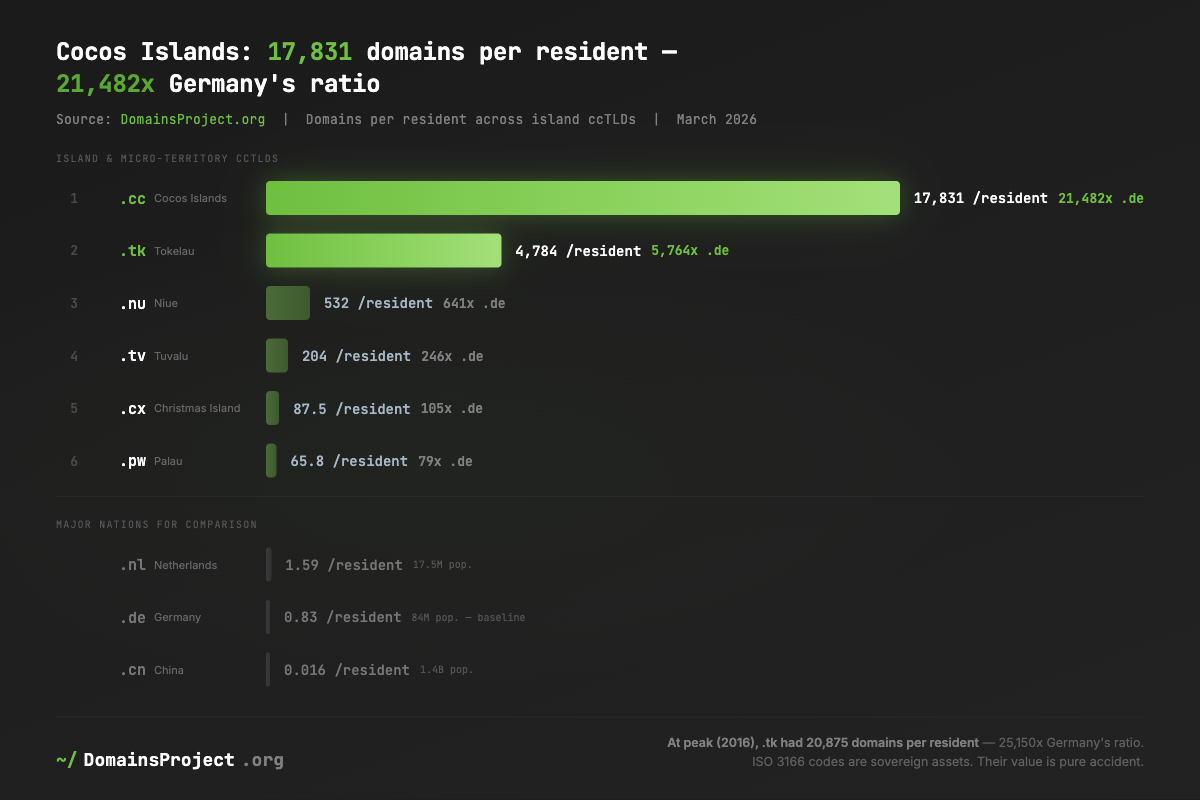
| .cc (Cocos Islands) | 19,353 | ~13,900x Germany's .de density |
| .tk (Tokelau) | 4,786 | ~3,440x Germany's .de density |
| .nu (Niue) | 555 | ~399x Germany's .de density |
| .tv (Tuvalu) | 209 | ~150x Germany's .de density |
| .de (Germany) | 1.39 | Baseline — world's largest ccTLD |
The Cocos Islands carry roughly 19,353 observed hostnames per resident — about 13,900 times Germany's density of 1.39 hostnames per capita. Germany operates the world's largest ccTLD by any normal measure, yet on a per-resident basis a territory of 600 people dwarfs it by four orders of magnitude. Tokelau's .tk shows 4,786 hostnames per resident, and this is the post-collapse figure — at its 2016 registration peak, .tk's 31.3 million registrations implied roughly 20,000 registrations per resident. The ratios are a direct consequence of how ISO 3166 distributes country codes: a code's commercial reach has nothing to do with the population behind it.
The Freenom Experiment: Free Domains, Massive Scale, Total Collapse
The .tk phenomenon began with a Dutch entrepreneur, a 36-hour boat ride, and routers purchased for $50 on eBay.
In 2000, Joost Zuurbier — based in Amsterdam — conceived a model inspired by Hotmail's free email: give away domain names, monetize the traffic with advertising. He traveled to Tokelau, installed Internet connectivity on all three atolls, and signed a deal in Hawaii in 2001. His company, OpenTLD B.V. (later branded Freenom), would operate .tk as a free-registration ccTLD. Tokelau would receive a share of revenue. It took five years to convince ICANN — officials insisted on meeting local elders to verify the arrangement was legitimate.
The Free-Registration Footprint Today
| ccTLD | Country | Population | Observed Hostnames | A-Resolution |
|---|---|---|---|---|
| .tk | Tokelau | ~1,500 | 7.2M | 2.5% |
| .ga | Gabon | ~2.4M | 5.9M | 1.4% |
| .ml | Mali | ~22M | 5.9M | 1.7% |
| .cf | Central African Republic | ~5.6M | 5.2M | 2.1% |
| .gq | Equatorial Guinea | ~1.7M | 4.5M | 1.7% |
| Total | ~33.2M | 28.6M | 1.9% |
A single Dutch company operated the domain registries of five sovereign nations and territories — four of them among the world's least developed countries — leaving 28.6 million observed hostnames still visible in our dataset. But almost none of it answers: across the five free-domain strings, just 1.9% of observed hostnames return a live A record, against a 58.9% whole-namespace rate. The 28.6 million figure is overwhelmingly residue — names registered for free, observed once by our crawler, and never pointed anywhere or long since deleted from the zone. The functional Freenom namespace is on the order of half a million resolving hostnames, not 28.6 million.
By 2012, CNN reported that .tk domain revenue accounted for "about one-sixth" of Tokelau's economy — though Teletok, the territory's telecommunications entity, later disputed this, telling MIT Technology Review that .tk revenue was "very small" and "nothing to my revenue." The revenue Freenom actually paid Tokelau was never publicly disclosed. Zuurbier claimed on LinkedIn that the arrangement "adds over 10% to the atolls' GDP." Other analysts estimated 10–20% of GDP, which would imply NZ$1.4 million to NZ$2.8 million per year — significant for a territory that receives NZ$4 million in annual New Zealand development aid, but a fraction of what the .tk zone was worth in aggregate advertising revenue.
The Abuse Economy: When Free Means Fraudulent
The structural problem with free domain registration was visible from the beginning. McAfee's 2007 "Mapping the Mal Web" report found that 10.1% of .tk websites contained malicious content — the worst rate of 265 TLDs examined. The incentive was straightforward: cybercriminals prefer disposable infrastructure, and a domain that costs nothing to register costs nothing to abandon when it gets flagged.
Freenom TLDs and Phishing
| Metric | Value | Source |
|---|---|---|
| Freenom ccTLDs in top 10 most-abused TLDs | 5 of 10 | Interisle Phishing Landscape 2022 |
| Freenom share of all ccTLD phishing domains | >60% | Cybercrime Information Center (Nov 2022) |
| Freenom share of all phishing attacks worldwide | 14% | Cybercrime Information Center |
| .tk phishing domains in single study period | Tens of thousands | Interisle 2021 |
| Freenom TLD domains on Cloudflare (pre-collapse) | 23.1% of all Cloudflare-hosted domains | Netcraft (March 2024) |
Five free-registration TLDs operated by a single company in Amsterdam accounted for 14% of all phishing attacks worldwide and more than 60% of all phishing on country-code domains, per the Cybercrime Information Center. Spamhaus coined a term for it — the "Freenom Effect" — describing what happens when a registry's abuse rate distorts security statistics across the entire ecosystem.
The reporting is consistent with our own resolution data: free registration with minimal identity verification let operators register hundreds of domains for phishing campaigns impersonating Facebook, Instagram, and WhatsApp, and re-register hundreds more at zero cost when those were blocked. The asymmetry was total — a phishing campaign using 100 paid domains costs $800–$1,500 in registration fees; the same campaign using free domains costs nothing. The 1.9% resolution rate we now observe across the five strings is the long-run signature of that churn: a namespace built on disposable registrations decays to near-zero live infrastructure.
The Collapse
In December 2022, Meta filed suit against Freenom in the Northern District of California, alleging trademark infringement, cybersquatting, and violations of the California Anti-Phishing Act. The complaint cited thousands of typosquatted Meta trademarks — domains like faceb00k.ga — and sought $500 million in damages (5,000 counts at $100,000 each under the Anti-Cybersquatting Consumer Protection Act). Separately, a Dutch investor sued in the Enterprise Chamber of the Amsterdam Court of Appeal, where judges found Freenom had violated corporate reporting rules and appointed a supervisory director.
| Date | Event |
|---|---|
| December 2022 | Meta sues Freenom for $500M; Dutch court appoints supervisory director |
| March 2023 | Freenom halts all new domain registrations |
| February 2024 | Freenom settles with Meta (undisclosed terms), announces exit from domain business |
| March 2024 | ~12.6 million Freenom domains go dark; Cloudflare loses roughly 22% of hosted domains overnight |
When Freenom stopped registrations in March 2023, phishing on its five TLDs fell sharply — which the Interisle Consulting Group described as natural-experiment evidence consistent with free registration being the primary driver of abuse, rather than some inherent property of the country codes. But the attackers did not disappear; reporting indicates they migrated to cheap new gTLDs, whose share of phishing domains rose markedly in the following year. Tokelau's telecommunications entity, Teletok, is now attempting to manage .tk directly, negotiating with New Zealand's .nz registry operator for technical assistance. The .tk zone, once the world's largest ccTLD by registration count, survives in our dataset as 7.2 million observed hostnames of which only 2.5% resolve — a digital ruin whose reputation as a phishing vector is likely permanent.
Tuvalu's .tv: How a Two-Letter Code Funded a Nation
Tuvalu's story is the counterpoint to Tokelau's — a case study in how a tiny nation can monetize its ccTLD without destroying it.
Tuvalu is nine islands in the South Pacific, population approximately 11,000, with no point higher than 4.6 meters above sea level. The country's GDP is roughly US$67 million. Climate projections suggest much of the capital Funafuti could flood by mid-century. By the standard metrics of national viability, Tuvalu should not matter to the global Internet.
But "TV" — Tuvalu's ISO 3166-1 alpha-2 country code — is universally understood as "television." That accident of alphabetic assignment created one of the most valuable ccTLDs on Earth.
The Deal History
| Period | Operator | Annual Payment to Tuvalu | Key Event |
|---|---|---|---|
| 1998-1999 | Information.CA (Chapnik) | ~$1M/quarter (briefly) | First deal; returns overpromised |
| 2000-2001 | dotTV / Idealab | $4M/year + $12.5M lump sum | Funded UN membership |
| 2002-2011 | VeriSign | ~$2M/year | Post-dot-com bust, lower rates |
| 2012-2021 | VeriSign (renewed) | ~$5M/year | Renegotiated upward |
| 2022-present | GoDaddy Registry | ~$10M/year | Doubled from VeriSign era |
The origin story reads like fiction. In 1998, Canadian entrepreneur Jason Chapnik negotiated .tv marketing rights and predicted $100 million per year in returns. When those projections collapsed, Pasadena venture firm Idealab interceded, forming dotTV Corporation and signing a deal worth approximately $50 million over 12 years — $1 million per quarter plus 20% equity in the new company.
With its first $1 million .tv payment, Tuvalu paid the approximately $100,000 fee to join the United Nations. On September 5, 2000, Tuvalu became the 189th member state — its seat at the table of global governance funded by a two-letter Internet code. The early payments also electrified outer islands and renovated the country's sole airstrip. Today .tv holds 2.3 million observed hostnames, of which 57.8% resolve — close to the whole-namespace average and roughly twenty-three times the resolution rate of Tokelau's free-domain .tk. The difference is the business model: a paid .tv domain is a domain someone is using.
Cumulative Revenue
| Period | Years | Estimated Annual | Subtotal |
|---|---|---|---|
| dotTV era (1998-2001) | ~3 | Varies | ~$17.5M |
| VeriSign early (2002-2011) | ~10 | ~$2M | ~$20M |
| VeriSign renewed (2012-2021) | ~10 | ~$5M | ~$50M |
| GoDaddy (2022-2026) | ~4 | ~$10M | ~$40M |
| Estimated Total | ~27 years | ~$127M+ |
Tuvalu has earned an estimated $127 million or more from .tv over 27 years — for a country whose entire annual GDP is $67 million. At the current $10 million per year, .tv domain revenue represents approximately $909 per citizen per year, or roughly 15% of per-capita GDP. By 2019, .tv royalties accounted for 8.4% of government revenue — a figure that has likely increased since GoDaddy doubled the annual payment. (These are external estimates compiled from contract disclosures and government reports, not figures from our dataset.)
The Streaming Multiplier
The story of .tv's value is inseparable from the story of streaming video. When VeriSign acquired dotTV Corporation for $45 million in 2001, the dot-com bust had deflated .tv's premium pricing. Streaming changed the equation entirely.
Twitch.tv — launched in 2011, acquired by Amazon for $1 billion in 2014 — is now among the most-visited websites globally. A single .tv website has more monthly active users (~140 million) than Tuvalu has citizens (~11,000) by a factor of over 12,000. Eurovision.tv, Fox News's foxnews.tv, and Dropout.tv all operate under Tuvalu's country code. The streaming era is consistent with why GoDaddy was willing to pay double VeriSign's rate: "tv" as a brand signal for video content is now worth more than it has ever been.
The Climate Paradox
Tuvalu faces an existential irony. The nation's highest point is 4.6 meters above sea level. The Intergovernmental Panel on Climate Change projects that a large share of Funafuti could be flooded by 2100. Tuvalu is investing .tv revenue into climate adaptation infrastructure and digital preservation of maritime boundaries.
.tv, a purely digital asset, may outlive the physical nation that owns it. If Tuvalu becomes uninhabitable — a scenario the government is actively planning for — the question of who controls a lucrative ccTLD with no resident population has no precedent in ICANN policy.
Niue's .nu: The Domain That Got Away
If Tuvalu is the success story, Niue is the cautionary tale — a case study in what happens when a small nation loses control of its digital sovereign asset.
Niue is a single raised coral island in the South Pacific, population approximately 1,800, in free association with New Zealand. More Niueans live in New Zealand (~30,000) than on the island itself. In 1997, American businessman Bill Semich approached Niue authorities and obtained delegation of the .nu ccTLD to his Massachusetts-based nonprofit, the Internet Users Society - Niue (IUSN). He reportedly told officials the domain "has no value" — comparable to an international dialing code. In exchange, he promised free unlimited Internet access for the island.
"Nu" means "now" in Swedish, Danish, and Dutch. In the late 1990s, Sweden's own .se domain was heavily restricted — registration required a Swedish corporate identity number. Swedish Internet users began registering .nu domains en masse as an accessible alternative. At peak, .nu held over 550,000 active registrations and became the third most popular TLD in Sweden with 7% market share, behind only .se and .com. Today .nu holds 999.1K observed hostnames, of which 62.4% resolve — a healthy, actively-used namespace, which is precisely what makes the dispute over who profits from it so contentious.
The Transfer and the Lawsuit
In 2013, the IUSN Foundation transferred .nu operations to the Swedish Internet Foundation (Internetstiftelsen, or IIS) — the same organization that operates Sweden's .se. Niue's government claims this transfer occurred without its consent. Since the transfer, IIS has earned approximately 210 million Swedish kronor (~$20-25 million) from .nu registrations.
| Date | Event |
|---|---|
| 1997 | Bill Semich obtains .nu delegation via IUSN |
| 2013 | IUSN transfers .nu operations to Swedish Internet Foundation (IIS) |
| November 2018 | Niue sues IIS in Stockholm District Court |
| December 2020 | Niue launches parallel ICANN proceedings for redelegation |
| March 2024 | Stockholm District Court rules in favor of IIS |
| June 2025 | Swedish Court of Appeal rejects Niue's appeal |
Niue estimates $150 million in total lost revenue across the IUSN and IIS periods. The Stockholm District Court found that IIS had "acted in accordance with applicable regulations" and did not require Niue's permission. Former Premier Toke Talagi called the ruling "a form of neo-colonialism."
The contrast with Tuvalu is stark. Both are tiny Pacific nations. Both hold ccTLDs with accidental commercial value in European languages. Tuvalu retained sovereign control, renegotiated progressively better deals, and now earns $10 million per year. Niue's ccTLD generates millions annually — for an organization in Stockholm. Niue receives nothing.
.tv vs. .nu: Two Models, Two Outcomes
| Dimension | .tv (Tuvalu) | .nu (Niue) |
|---|---|---|
| Population | ~11,000 | ~1,800 |
| Domain meaning | Television (global) | "Now" (Swedish/Danish/Dutch) |
| Observed hostnames | 2.3M | 999.1K |
| A-resolution rate | 57.8% | 62.4% |
| Annual revenue to country | ~$10M | ~$0 (disputed) |
| Cumulative revenue | ~$127M+ | Minimal |
| Country retains control | Yes | No |
| Current operator | GoDaddy Registry | Swedish Internet Foundation |
The difference is not the value of the code, and it is not the health of the namespace — both .tv and .nu resolve near or above the 58.9% whole-namespace average, so both are genuinely used. The difference is who controls the revenue. Tuvalu negotiated as a sovereign government, hired lawyers, demanded equity stakes, and switched operators when better terms were available. Niue delegated to an American nonprofit that transferred operations to a Swedish foundation, and is now fighting in foreign courts to reclaim what was always its national asset.
The Broader Lottery: From .io to .ai
Tokelau, Tuvalu, and Niue are the most dramatic cases, but the pattern extends across the Pacific and beyond. Small territories hold disproportionately large namespaces because ISO 3166 country codes were assigned based on geography, not demographics — and commercial value follows linguistic coincidence, not population.
The Linguistic Lottery
| ccTLD | Territory | Code Meaning | Commercial Appeal | Observed Hostnames | A-Resolution |
|---|---|---|---|---|---|
| .io | British Indian Ocean Territory | Indian Ocean | Input/output (tech) | 13.8M | 56.3% |
| .cc | Cocos Islands | Cocos → CC | Generic alternative to .com | 11.6M | 49.7% |
| .me | Montenegro | Montenegro → ME | English pronoun ("about.me") | 9.6M | 46.6% |
| .ai | Anguilla | Anguilla → AI | Artificial intelligence | 4.1M | 77.2% |
| .tv | Tuvalu | Tuvalu → TV | Television / streaming | 2.3M | 57.8% |
| .to | Tonga | Tonga → TO | English preposition (go.to) | 1.0M | 76.5% |
| .nu | Niue | Niue → NU | "Now" in Scandinavian languages | 999.1K | 62.4% |
| .ws | Samoa | Western Samoa | "WebSite" (marketed) | 707.8K | 86.7% |
| .fm | Micronesia | Federated States of Micronesia | FM radio / podcasting | 153.0K | 77.9% |
None of these nations chose their codes. ISO 3166 assigned them based on country names and colonial-era geography. "TV" happened to mean television; "IO" happened to resonate with software developers; "AI" happened to match the biggest technology trend of the decade; "ME" happened to be an English pronoun. The commercial value is largely accidental — and for the territories that recognized it early, that accident became a national resource.
.io is the extreme case: the British Indian Ocean Territory has no permanent civilian population (it is a US-UK military facility on Diego Garcia), yet .io holds 13.8 million observed hostnames — the 28th-largest TLD in our dataset, resolving at a respectable 56.3%. The tech industry adopted .io as its de facto startup domain, and the territory's ccTLD now carries more of the Internet than most nations' entire digital infrastructure. (The full .io story — including the sovereignty questions raised by the 2024 Chagos transfer — is the subject of our .io companion analysis.) .cc is similar: VeriSign acquired the Cocos Islands' ccTLD operator in 2001, and 11.6 million hostnames now resolve under a code belonging to a territory of 600 people.
Resolution rates separate the commercial strings from the free-domain wreckage. The marketed ccTLDs above resolve between 46.6% (.me) and 86.7% (.ws) — clustered around or above the whole-namespace 58.9% rate — because each registration is a paid transaction someone has a reason to keep live. That is a different universe from the Freenom strings, which resolve at 1.4–2.5%. The branding accident determines the headline size of a namespace; the pricing model determines how much of it actually answers.
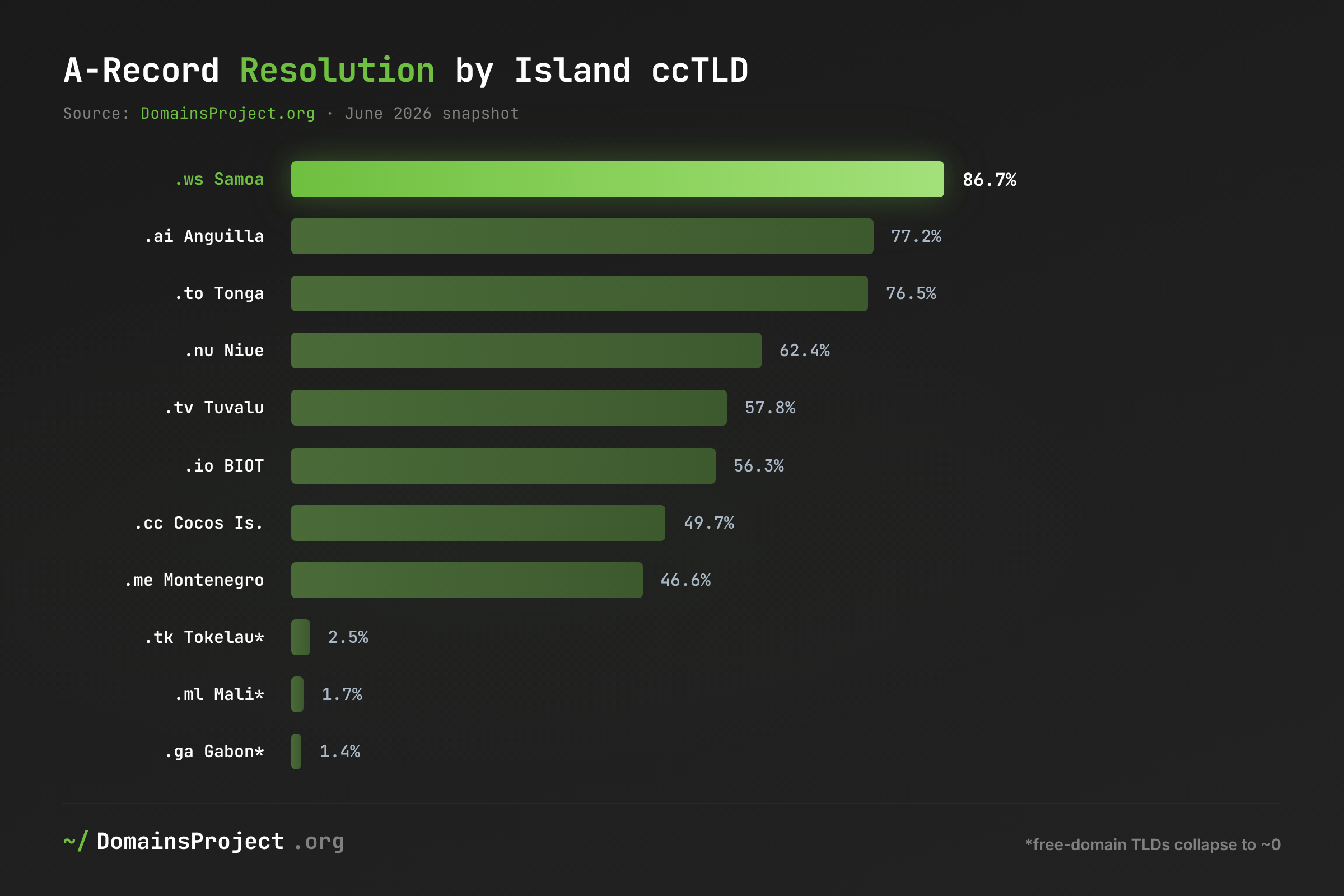
.fm and .ws show niche branding done well. BRS Media has operated .fm since 1998, initially targeting radio stations, but the rise of podcasting transformed the domain's market; the Federated States of Micronesia earns a revenue share through a partnership renewed for over 26 years, and .fm resolves at 77.9% — among the highest in this cohort, consistent with a small but committed paid user base. Samoa's .ws, marketed as "WebSite," resolves at 86.7%, the highest in the table.
The biggest current bet is the artificial-intelligence boom on Anguilla's .ai. Anguilla, a Caribbean island of roughly 16,000 people, holds 4.1 million .ai hostnames resolving at 77.2% — among the liveliest namespaces of any size in our dataset. Unlike the free-domain strings, these are overwhelmingly paid registrations at premium prices, which is exactly why so many of them resolve. We treat .ai in depth — including the registration revenue that now rivals the island's public budget — in our .ai companion study. The .xyz namespace, the new-gTLD analogue of this story, has its own dedicated analysis.
What's at Stake
The island TLD data reveals structural patterns that extend far beyond the Pacific:
- Ten island territories with a combined population under 500,000 host 39.1 million observed hostnames — more than France's entire .fr namespace is just above, and over half the size of .org. This is consistent with ccTLD scale being determined by linguistic coincidence and commercial branding, not by the country's population, economy, or Internet infrastructure. ISO 3166 codes are sovereign assets whose value is largely accidental.
- The free-registration model produced the Internet's largest abuse vector and almost no surviving infrastructure — Freenom's five ccTLDs were reported at 14% of all phishing attacks worldwide and more than 60% of all ccTLD phishing, and our crawl now finds just 1.9% of their 28.6 million observed hostnames resolve. When registrations stopped, reported phishing fell sharply — natural-experiment evidence consistent with zero-cost registration driving the abuse.
- Tuvalu has earned an estimated $127 million from .tv over 27 years — roughly twice the nation's annual GDP — by retaining sovereign control and renegotiating with successive operators, and .tv resolves at 57.8%, near the whole-namespace average. This is consistent with sovereign ownership plus competitive bidding being the durable model for small-nation ccTLD monetization.
- Niue has earned effectively nothing from .nu despite the domain generating $20-25 million for its Swedish operator — and .nu is no dead namespace: at 62.4% resolution it is among the healthiest small ccTLDs, which makes the lost revenue, upheld by Swedish courts and unresolved by ICANN, a live grievance rather than a footnote.
- Resolution rate, not registration count, separates a working namespace from a promotional one — the marketed island ccTLDs (.io 56.3%, .tv 57.8%, .nu 62.4%, .ai 77.2%, .ws 86.7%) cluster around or above the 58.9% whole-namespace rate, while the free-domain strings sit near zero. Any registration model that approaches zero cost attracts abuse and decays to near-zero live infrastructure.
- Climate change creates an unprecedented governance question for .tv — if Tuvalu becomes uninhabitable within decades, a $10-million-per-year ccTLD will exist without a resident population, and ICANN has no framework for ccTLD governance when the "country" in "country-code" ceases to physically exist.
What Would Help
1. Small nations: treat your ccTLD as sovereign critical infrastructure, not a licensing deal. Tuvalu's progressive negotiation — from ~$2 million per year to ~$10 million, with operator changes when terms stalled — demonstrates the approach. Niue's delegation to a foreign nonprofit without meaningful oversight demonstrates the risk. Any nation that has outsourced ccTLD operations should review its contract terms, revenue share, and reversion rights with the same seriousness it applies to fisheries licenses or mineral rights.
2. ICANN: establish binding standards for ccTLD delegation and sovereign consent. The .nu dispute — where a Pacific island nation has spent six years in Swedish courts trying to reclaim its country code — exposes a governance gap. ICANN's ccTLD delegation framework should require demonstrable sovereign consent for any transfer of operational control, with automatic reversion mechanisms when consent is disputed. The current system allowed a Massachusetts nonprofit to transfer a nation's digital identity to a Swedish foundation without that nation's agreement.
3. Security researchers: use the Freenom shutdown as a natural experiment. The March 2023 registration halt and March 2024 domain kill produced an unusually clean before-and-after dataset in phishing research. Our resolution pass quantifies the aftermath: 1.9% of the five strings' observed hostnames resolve, the long-run signature of disposable-registration churn. Researchers should analyze the migration patterns — which TLDs absorbed the displaced abuse, at what rates, and whether price thresholds exist below which abuse becomes inevitable. Start with our TLD statistics pages for .tk, .cf, .ml, .ga, and .gq.
4. Registries and ICANN: establish minimum pricing floors to prevent the next Freenom. The data is consistent and unambiguous: TLDs with registration costs approaching zero attract abuse rates orders of magnitude higher than paid TLDs, and decay to near-zero resolution. A minimum wholesale price — even $1 per domain per year — would remove the economic incentive for disposable phishing infrastructure without materially affecting legitimate registrations.
5. Climate and governance researchers: address the .tv precedent before it becomes urgent. Tuvalu is actively planning for the possibility that its islands become uninhabitable, including digital preservation of maritime boundaries and sovereignty. .tv — worth ~$10 million per year and resolving at 57.8% — needs to be part of that planning. ICANN, the Pacific Islands Forum, and the UN should establish frameworks for ccTLD continuity when sovereign states face existential geographic threats. The precedent set for .tv will apply to every low-lying nation with a ccTLD.
This analysis was conducted using the DomainsProject dataset, which continuously indexes observed hostnames across the active TLDs in the IANA root zone (Russian-administered TLDs excluded). Hostname counts reflect the June 2026 snapshot (1,511 TLDs, 3,183,285,503 observed hostnames); resolution figures reflect our 9 June 2026 A-record crawl. Historical .tk registration figures are from ZookNIC/Verisign Domain Name Industry Briefs and Freenom corporate filings. Tuvalu revenue estimates are compiled from dotTV Corporation records, VeriSign contract disclosures, GoDaddy Registry announcements, and government financial reports. Niue legal proceedings are sourced from Stockholm District Court filings and ICANN correspondence. Phishing data is from the Interisle Consulting Group Phishing Landscape reports (2021-2024), the Cybercrime Information Center, Spamhaus, and APWG. Explore island TLD statistics on our TLD statistics pages, browse the full TLD dashboard, or access the complete dataset for your own research.