Updated 23 June 2026 — refreshed against the June 2026 dataset snapshot (36,326,261 observed .nl hostnames, rank #11 of 1,511 TLDs) and triangulated against our 9 June 2026 A-record crawl. The original March 2026 edition predated our data-journalism format standard and our first-party DNS resolution data. This revision adds a full Methodology section, replaces loose "domain" counts with deduplicated observed-hostname counts, adds a per-capita density comparison and an A-resolution pass, and corrects the dataset figures. The single biggest correction: the original reported 27.8 million .nl hostnames against an older, less-deduplicated pipeline; the current deduplicated snapshot counts 36.3 million. This is a recount on a changed counting method — not a measurement of the namespace growing or shrinking — and registry-level registration trends (which did contract) are now sourced and labelled separately from our hostname counts.
On 1 May 1986, a system administrator named Piet Beertema registered cwi.nl — a domain for the Centrum Wiskunde & Informatica, a mathematics institute in Amsterdam. It was the first active country-code domain registration outside the United States. Beertema had applied to Jon Postel at IANA for the .nl delegation just days earlier. He would go on to manage the entire .nl namespace single-handedly from his room at CWI for the next ten years, handling the first 10,000 registrations by himself. In 1999, Queen Beatrix awarded him Knight of the Order of the Netherlands Lion.
A Reddit user f00dit asked us to break down the Netherlands' .nl domain. The Netherlands is not just a country that has a lot of domains. It is the country that built much of the infrastructure the rest of the Internet runs on — and the shape of the .nl namespace is consistent with that role in ways registry statistics alone do not reveal.
The numbers at the registry level tell one story: roughly 6.06 million .nl registrations (SIDN, end 2025), the third-largest ccTLD in Europe, among the highest ccTLD densities per capita of any large country. Solid but not remarkable. Our dataset tells a denser one: 36.3 million observed hostnames under .nl — about 2.03 observed hostnames for every Dutch resident, the highest such ratio of any major European ccTLD. A large share of those hostnames are not websites at all but ISP reverse-DNS records, the automatically-assigned names Dutch broadband providers attach to residential connections. The dataset reads less like a list of registered businesses and more like a census of Dutch Internet infrastructure itself.
We parsed 36,326,261 observed hostnames in the .nl namespace from the DomainsProject dataset, ran our 9 June 2026 A-record crawl against them, and cross-referenced the result with SIDN registry statistics (end 2025), SIDN Labs research data, AMS-IX traffic reports, and historical sources from CWI, NLnet, and SURFnet.
The headline: about 17.9 million people give the Netherlands an outsized claim on the Internet's core infrastructure — the first active ccTLD (1986), the world's largest Internet exchange by member count (AMS-IX, 1,000+ members, 14 Tbps peak), the headquarters of RIPE NCC (the regional Internet registry for Europe, the Middle East, and Central Asia), the birthplace of NSD and Unbound (DNS software that powers root servers and ISPs worldwide), and a multi-billion-dollar data center market concentrated in Amsterdam. Our dataset captures 36.3 million .nl observed hostnames — roughly 6x the registry count — a multiplier consistent with Dutch ISPs assigning resolvable reverse-DNS to millions of broadband connections. And 71.7% of those hostnames return a live IPv4 address in our June 2026 crawl, far above the 58.9% whole-namespace rate. The hostname count is a recount, not a contraction; the registry-level registration base, separately, did peak around 6.35 million in mid-2023 and has since edged down, which SIDN attributes to declining business formation and a collapse in youth domain registration intent from 55% to under 20% in two years.
The Data
DomainsProject continuously crawls and indexes hostnames across every delegated TLD in the IANA root zone. For this analysis, we parsed the full .nl namespace — all 36,326,261 observed hostnames — to understand what they actually represent.
| Category | Count | Coverage |
|---|---|---|
| Active TLDs tracked | 1,511 | IANA root zone (Russian-administered TLDs excluded) |
| Total observed hostnames | 3,183,285,503 | Largest public dataset |
| .nl observed hostnames | 36,326,261 | 1.14% of dataset |
| .nl global rank (all TLDs) | #11 | Major European ccTLD |
| .nl ccTLD rank | #7 | Behind .de, .jp, .cn, .br, .uk, .fr |
| .nl hostnames returning a live A record | 26,030,414 | 71.7% resolution rate |
| SIDN registry registrations | ~6,060,000 | Official count (end 2025) |
Our 36.3 million figure includes every observed hostname under .nl — subdomains, ISP reverse-DNS entries, hosting-platform subdomains, and the bare registered domains themselves. The roughly 6x multiplier between our observed-hostname count and SIDN's ~6.06 million registrations is consistent with the depth of Dutch broadband infrastructure, where ISPs assign individual reverse-DNS hostnames to residential connections as a matter of routine. This is not noise — it is the fingerprint of a country where broadband penetration reached 99% and a large fraction of cable modems received a name. (As the Methodology notes, the multiplier should not be read against the original edition's 27.8 million figure as growth: that number came from an earlier, less-deduplicated counting pass, and the change is a recount.)
Methodology
This post makes quantitative claims about a single national namespace, so the definitions matter.
- Observed hostname (FQDN). Our base unit: a fully-qualified name seen in our crawl.
example.nl,www.example.nl, andmail.example.nlare three distinct hostnames under one registrable domain. The 36,326,261 figure is deduplicated observed hostnames, not registrations and not apex-only counts — which is why it runs well above SIDN's ~6.06M registration total. - Apex / registrable domain. A registered
name.nl(or a third-level public-suffix registration such asname.co.nl). We resolve the public suffix using the ICANN section of the Public Suffix List. We do not report an exact apex count here because it is not part of the published snapshot; where the original edition cited a precise second-level total, this revision drops it in favour of the observed-hostname total and the registry registration count. - Registry registrations. SIDN's count of registered .nl domains (~6.06M, end 2025). This is a different quantity from our observed-hostname total. Throughout, "registrations" and "registered domains" mean the registry figure (sourced to SIDN); "observed hostnames" or "hostnames" mean our dataset figure. The contraction trend is a registry-side measure and is sourced to SIDN, not inferred from our crawl.
- ISP reverse-DNS. Names that broadband providers attach to residential IP addresses (patterns such as
*.dynamic.<isp>.nl). These resolve and are real DNS records, but they are infrastructure addresses rather than registered sites. We characterise the ISP share of .nl qualitatively: per-provider hostname tallies are not part of the published snapshot, so figures the original edition gave for individual providers are described here as approximate and indicative, not exact. - A-resolution rate. Our 9 June 2026 A-record crawl records hostnames that returned a live IPv4 address (
NOERRORwith at least one A record). .nl's rate is 26,030,414 of 36,326,261 = 71.7%, measured per observed hostname. The crawl is positive-only, so this is a liveness floor: a live A record can still point at a parked page, and a name reachable only over IPv6 reads as non-resolving and is undercounted. The whole-namespace rate for comparison is 58.9%. - Per-capita density. Observed hostnames divided by national population (Netherlands ≈ 17.9M; other countries from comparable 2025–2026 estimates). This normalises namespace size against population so a small, dense country can be compared with a large one; it is a structural ratio, not a per-person registration count.
Dataset vs. registry, and known limitations. Our 36.3M observed-hostname count diverges from SIDN's ~6.06M registrations because we count every observed FQDN (inflating relative to apexes) but only names our crawl has actually seen (deflating relative to zone-file totals). The net effect for a heavily-subdomained, reverse-DNS-rich ccTLD like .nl is a count several times the registration base. This is a single snapshot: it measures presence and resolution, not query volume, uptime, or registry revenue. The 36.3M figure is not comparable to the original edition's 27.8M as a time series — the two come from different deduplication pipelines, and the change is a recount, not namespace growth. Russian-administered TLDs are excluded from the dataset and from every total here, per project policy. The per-TLD breakdown is reproducible from the .nl statistics page and the dataset.
The Scorecard: The Densest Namespace in Europe
.nl Among the Major European ccTLDs
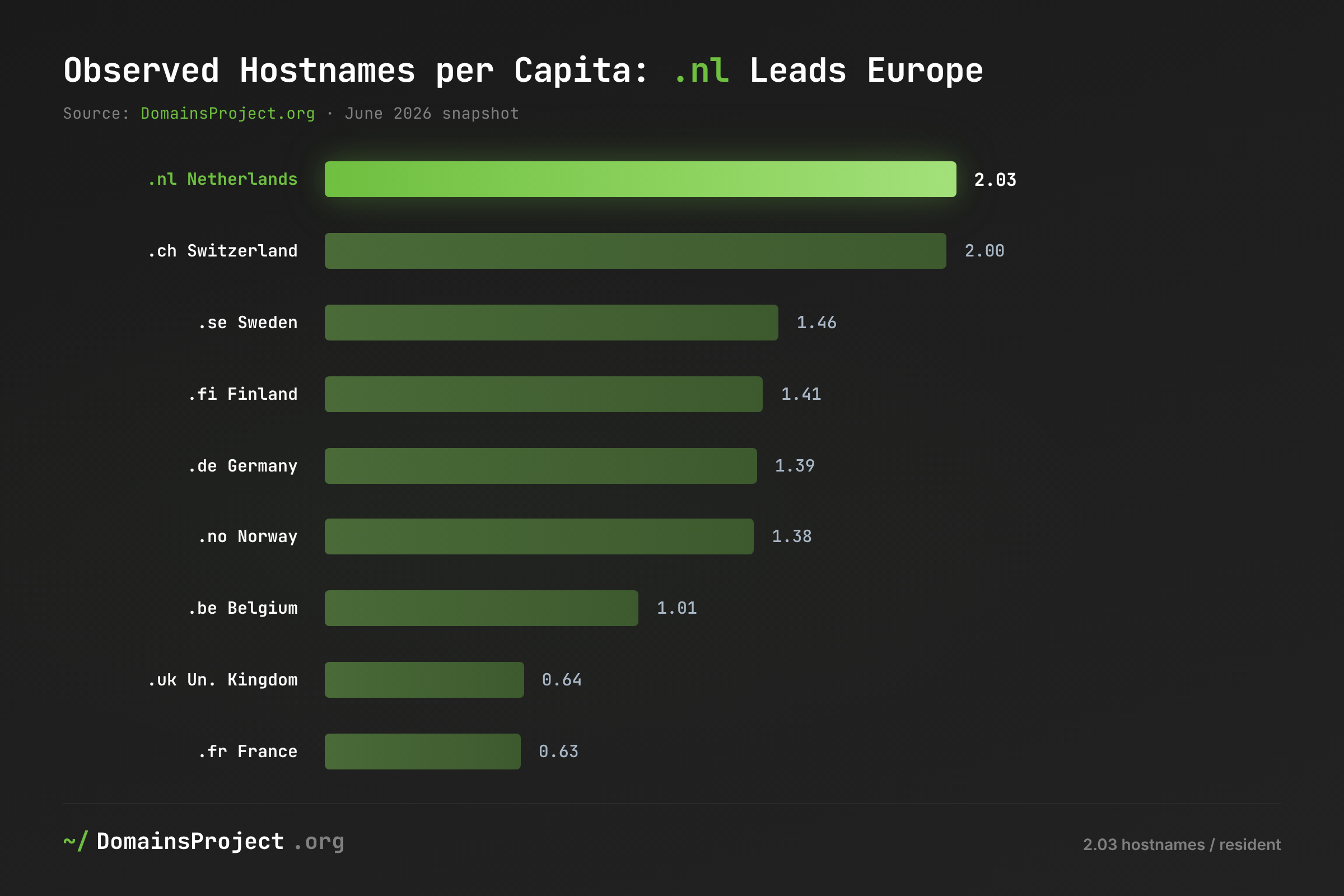
| ccTLD | Observed hostnames | Population (approx.) | Hostnames per capita |
|---|---|---|---|
| .nl (Netherlands) | 36,326,261 | 17.9M | 2.03 |
| .ch (Switzerland) | 17,788,317 | 8.9M | 2.00 |
| .se (Sweden) | 15,477,824 | 10.6M | 1.46 |
| .fi (Finland) | 7,877,814 | 5.6M | 1.41 |
| .de (Germany) | 117,679,029 | 84.5M | 1.39 |
| .no (Norway) | 7,612,900 | 5.5M | 1.38 |
| .be (Belgium) | 11,967,717 | 11.8M | 1.01 |
| .uk (United Kingdom) | 43,805,896 | 68.3M | 0.64 |
| .fr (France) | 43,106,389 | 68.4M | 0.63 |
At about 2.03 observed hostnames per resident, .nl is the densest national namespace in Europe — narrowly ahead of Switzerland (2.00) and well clear of the next tier (Sweden 1.46, Finland 1.41, Germany 1.39). Density is the metric where the Netherlands' infrastructure role becomes legible: a country with one-fifth of Germany's population sustains a namespace nearly a third its size. The ratio does not, on its own, prove the "infrastructure hub" thesis — heavy ISP reverse-DNS inflates it, and the comparison mixes registry models — but the pattern is consistent with it, and the next two sections triangulate the density signal against resolution and ISP composition.
How Much of .nl Actually Resolves
| Slice | Count | Returns live A record | Resolution rate |
|---|---|---|---|
| All observed .nl hostnames | 36,326,261 | 26,030,414 | 71.7% |
| Whole-namespace (all 1,511 TLDs) | 3,183,285,503 | — | 58.9% |
71.7% of observed .nl hostnames return a live IPv4 address — nearly 13 points above the 58.9% whole-namespace rate. High density paired with high resolution is the signature this post calls the "quiet backbone": a namespace this large could in principle be padding (the promotional gTLDs sit at 25–40% resolution), but .nl resolves at a rate closer to mature, business-oriented ccTLDs such as .de (75.2%) and .fr (68.5%). The data → inference chain is narrow but defensible: a high observed-hostname count that also resolves at a high rate is more consistent with live hosting and ISP infrastructure than with parked or speculative inventory. (Caveat: a live A record is a liveness floor, not an active-site census — reverse-DNS records for residential connections resolve too, and they are infrastructure rather than published sites.)
The ISP Fingerprint: Reverse-DNS at National Scale
A large share of the .nl namespace is not websites at all. It is the reverse-DNS records Dutch broadband providers assign to residential connections — names like *.dynamic.ziggo.nl or adsl.xs4all.nl that resolve but front no published content. The published snapshot does not break out per-provider hostname tallies, so the figures below are described as approximate and indicative; the structural point does not depend on the exact counts.
Reverse-DNS from a handful of ISPs accounts for a substantial minority of all .nl hostnames — chiefly Ziggo (VodafoneZiggo, the largest cable operator), the legacy Chello/UPC brand, and KPN's former XS4ALL. This is unusual at scale and is a structural feature of Dutch Internet culture: providers here assign individual, resolvable reverse-DNS hostnames to residential connections as a matter of routine, where many national ISPs use shared or anonymised PTR space. The effect is to make the .nl namespace double as a partial map of Dutch broadband itself — which is also why its per-capita density runs so far ahead of its registry registration count.
Ziggo: The Dominant Infrastructure
VodafoneZiggo's hybrid fiber-coaxial network passes roughly 7 million Dutch homes — most of the country — and a large fraction of those connections leave a trace in the global DNS as dynamic.ziggo.nl and similar reverse-DNS names. These entries are not websites; they are the addresses of Dutch living rooms. Their volume is the single largest reason .nl's observed-hostname count runs several times its registration base, and the single largest contributor to the country's leading per-capita density. (Per-provider totals are indicative; the published snapshot reports the .nl total, not a provider breakdown.)
XS4ALL: A Ghost in the Data
The XS4ALL reverse-DNS records in our dataset are a digital tombstone. XS4ALL — "Access for All" — was shut down by its parent company KPN on 24 December 2021. The brand no longer exists. But reverse-DNS hostnames in patterns such as adsl.xs4all.nl and ip.xs4all.nl persist in the namespace. These are the ghosts of a provider that was not just an ISP but a cultural institution — and the DNS has not forgotten it. (The counts the original edition attached to each XS4ALL pattern came from an earlier pass and are omitted here, as the current snapshot does not publish per-pattern tallies.)
The First Active ccTLD: How the Netherlands Got .nl
The United Kingdom's .uk was delegated on 24 July 1985. But the Netherlands' .nl, delegated on 25 April 1986, was the first country-code TLD outside the US to have an actual domain name registered and actively resolving. cwi.nl — registered 1 May 1986 — is older than every other ccTLD domain outside American soil.
On 17 November 1988, at 2:28 PM, Piet Beertema connected CWI to NSFNET — making the Netherlands the first European country on the public Internet. France's INRIA followed shortly after. The connection ran through EUnet, the European Unix network whose main node operated out of CWI. From that single link in Amsterdam, much of Europe's early Internet connectivity was bootstrapped.
.nl Registration History
| Year | Milestone | Context |
|---|---|---|
| 1986 | cwi.nl registered (1 May) | First active ccTLD domain outside the US |
| 1988 | Netherlands connected to Internet (17 Nov) | One of first two European countries online |
| 1996 | SIDN founded (31 Jan) | Beertema, Lindgreen, Nederkoorn |
| 2003 | 1 million .nl domains | Registration opened to individuals (June) |
| 2010 | 4 million .nl domains | Rapid growth phase |
| 2012 | 5 million .nl domains | September milestone |
| 2020 | 6 million .nl domains | deyogiclub.nl was the 6 millionth (June) |
| 2023 | Peak: ~6.35 million | Mid-year, before contraction began |
| 2025 | ~6.06 million | First sustained decline in .nl history |
It took 17 years to reach the first million (1986-2003) and only 17 more to reach six million. The inflection point was June 2003, when SIDN opened .nl registration to individuals worldwide — previously, only businesses and organizations could register. Hans Kraaijenbrink, SIDN's first CEO, led the reform. He died the same year it took effect. The growth it triggered was explosive: 1 million to 6 million in 17 years.
But Beertema's contribution extends beyond the Netherlands. He developed a "DIY package" — technical instructions enabling colleagues across Europe to apply for and operate their own country-code domains. .de, .fr, .se, .fi — the ccTLDs that now represent some of the largest namespaces on Earth were bootstrapped, in part, by a system administrator in Amsterdam who had figured out the process first.
The Hacker ISP: XS4ALL and the Culture of Dutch Internet Freedom
XS4ALL was not founded by telecommunications engineers or business executives. It was founded by hackers.
In 1989, Rop Gonggrijp launched Hack-Tic — a Dutch hacker magazine inspired by Hamburg's Chaos Computer Club magazine Datenschleuder and New York's 2600. That same summer, Gonggrijp, Caroline Nevejan, and Patrice Riemens organized the Galactic Hacker Party at Paradiso, Amsterdam's legendary music venue. The event brought together hackers from across Europe and established Amsterdam as a center of hacker culture alongside Hamburg and Berlin.
In 1993, the Hack-Tic collective founded XS4ALL — "Access for All" — the sixth ISP in the Netherlands and the second to offer Internet access to individual citizens. The name was a mission statement. Internet access was a right, not a product. The founding team — Felipe Rodriquez, Rop Gonggrijp, Paul Jongsma, Cor Bosman — came from the hacker underground, not the telecom industry.
XS4ALL was sold to KPN in December 1998 but retained its identity as an independent subsidiary. It became the ISP of choice for the Netherlands' technically literate: researchers, developers, privacy advocates. The adsl.xs4all.nl reverse-DNS records that still surface in our dataset are not random broadband customers. They are the addresses of a specific Dutch digital culture that outlived the brand.
From Hacker Culture to National Policy
The hacker ethos that created XS4ALL did not stay underground. It shaped Dutch law.
| Year | Event | Significance |
|---|---|---|
| 1989 | Hack-Tic magazine launched | Dutch hacker media |
| 1989 | Galactic Hacker Party at Paradiso | Amsterdam as hacker capital |
| 1993 | XS4ALL founded by Hack-Tic hackers | "Access for All" |
| 2012 | Netherlands enacts net neutrality law | First in Europe, second globally (after Chile) |
| 2019 | KPN announces XS4ALL shutdown | 50,000+ petition signatures |
| 2019 | Freedom Internet launched | Crowdfunded EUR 2.5M as ideological successor |
| 2021 | XS4ALL brand discontinued (24 Dec) | End of an era |
The Netherlands became the first European country — and the second in the world after Chile — to enact a net neutrality law on 4 June 2012. The legislation emerged from the same digital rights culture that produced XS4ALL. This was not coincidence. When KPN announced it would kill the XS4ALL brand in January 2019, over 50,000 people signed a petition to save it — including former board members and the original founders. When the brand died on Christmas Eve 2021, a crowdfunded successor called Freedom Internet had already raised EUR 2.5 million to continue the mission.
No other country has a direct, traceable line from a hacker magazine to a commercial ISP to a national net neutrality law. The Netherlands does.
The Infrastructure Nation: Why Amsterdam Matters
The Netherlands did not just connect to the Internet early. It became the Internet's physical infrastructure for Europe.
Amsterdam's Internet Infrastructure
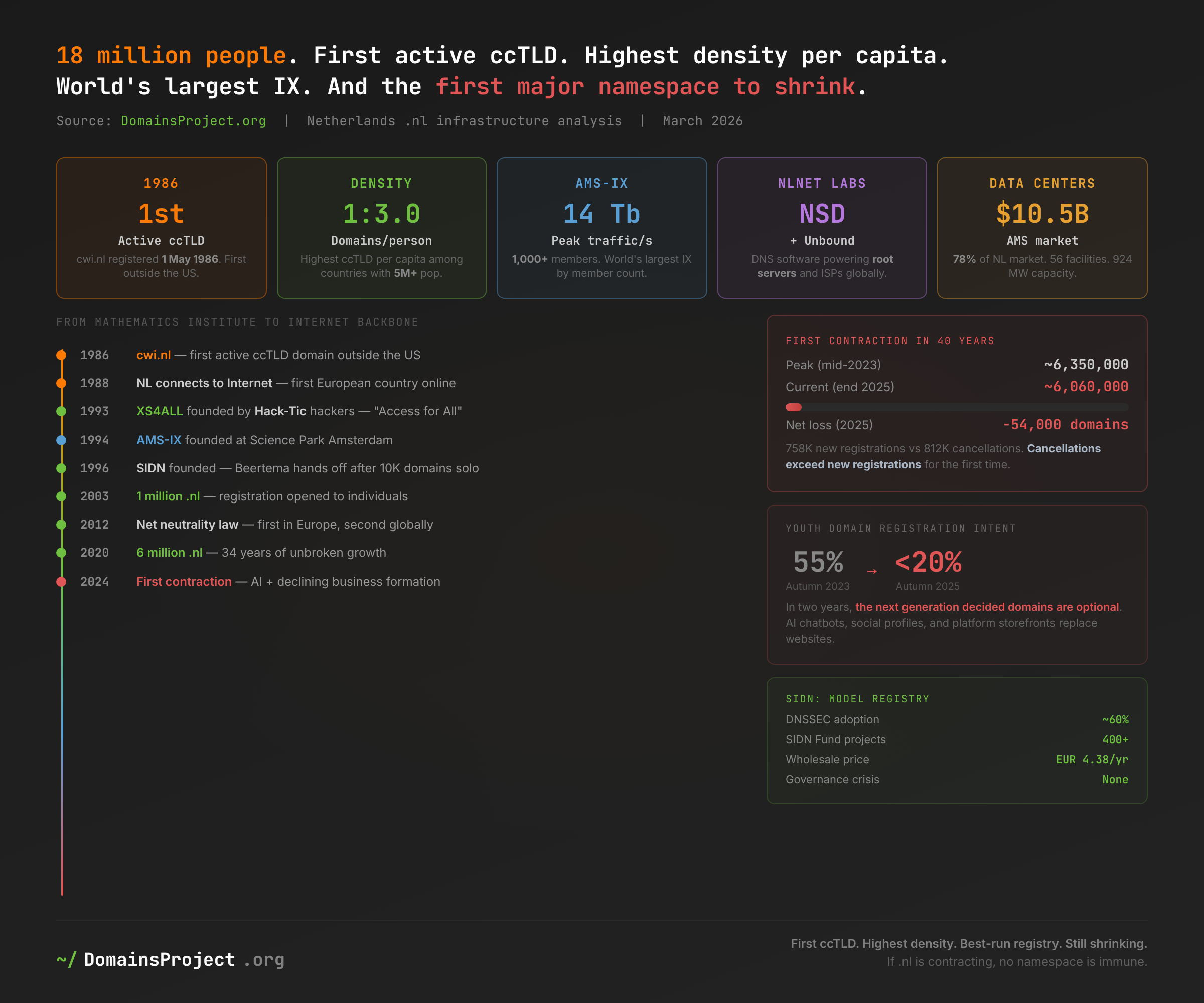
| Asset | Scale | Global Significance |
|---|---|---|
| AMS-IX | 1,000+ members, 14 Tbps peak (Dec 2024) | World's largest IX by member count |
| RIPE NCC | Europe/ME/Central Asia registry | HQ at Amsterdam Central Station |
| NLnet Labs | NSD, Unbound, OpenDNSSEC, Krill | DNS software used by root servers globally |
| Data centers | $10.5B market, 78% in Amsterdam | 56 advanced facilities, 924 MW capacity |
| AMS-IX traffic | ~2.9 EB/month (Sep 2024) | ~20% annual growth |
AMS-IX — the Amsterdam Internet Exchange — was founded in February 1994 at Science Park Amsterdam by NIKHEF, SARA, CWI, SURFnet, and NLnet. Thirty years later, it is one of the world's largest Internet exchange points: over 1,000 connected parties from around the globe, 14 Tbps peak traffic in December 2024, approximately 2.9 exabytes of traffic per month. It operates seven Internet exchanges worldwide.
NLnet Labs, founded in Amsterdam in 1999, produces DNS software that the entire Internet depends on. NSD (Name Server Daemon) is an authoritative DNS server used by multiple root server operators and ccTLD registries. Unbound is a validating, recursive DNS resolver deployed by major ISPs worldwide. OpenDNSSEC automates DNSSEC key management. Krill and Routinator secure BGP routing through RPKI. All BSD-licensed. All free. All Dutch.
RIPE NCC — the Regional Internet Registry for Europe, the Middle East, and Central Asia — has been headquartered in Amsterdam since it began operations in April 1992. Its offices are in the east wing of Amsterdam Central Station, with 175+ staff from 40+ countries. Every IP address allocation in its service region passes through Amsterdam.
The concentration is not accidental. NLnet Foundation — the organization that funded NLnet Labs — traces its roots to 1982, when it helped build EUnet, the European Unix network whose main node was at CWI. Amsterdam's position as Europe's Internet hub was established before the commercial Internet existed, and it compounded from there: the exchange drew the data centers, the data centers drew the cloud providers, and the cloud providers drove Amsterdam's data center market to $10.5 billion.
The Freenom Irony
One other organization headquartered in Amsterdam deserves mention: Freenom — the company that operated .tk, .cf, .ga, .gq, and .ml, the five most-abused domain extensions on Earth. Joost Zuurbier's OpenTLD BV, which offered free domain registrations that at their peak accounted for 14% of all global phishing, operated from the same city as RIPE NCC, AMS-IX, NLnet Labs, and SIDN.
Amsterdam simultaneously hosted the organizations that built the Internet's security infrastructure and the company that did more to undermine it than any other single entity. Meta's $500 million lawsuit, filed in 2022, led to Freenom halting registrations in March 2023 and settling in February 2024. But the irony remains: the world's most notorious domain abuse operation was Dutch.
SIDN: The Model Registry
SIDN (Stichting Internet Domeinregistratie Nederland) was co-founded by Piet Beertema on 31 January 1996 — the point at which managing .nl from a single room at CWI was no longer tenable. Headquartered in Arnhem with approximately 110 employees, SIDN manages .nl through 1,058 active registrars.
SIDN vs. DENIC vs. Nominet
| Metric | SIDN (.nl) | DENIC (.de) | Nominet (.uk) |
|---|---|---|---|
| Legal structure | Foundation + BV (since 2023) | Non-profit cooperative | Not-for-profit company |
| Registry registrations | ~6.06M | ~17.7M | ~10.3M |
| Wholesale price | EUR 4.38/year | EUR 2.20/year | GBP 3.90/year |
| Estimated revenue | ~EUR 26.7M | ~EUR 39M | GBP 56.4M |
| DNSSEC adoption | ~60% | ~40% | ~10% |
| Research lab | SIDN Labs (since 2011) | — | — |
| Public fund | SIDN Fund (>EUR 2M/year, 400+ projects) | — | Nominet Trust (abandoned 2018) |
| Governance crisis | None | None | 2021: CEO +117% pay, charity -65% |
| Namespace trend | Contracting (-1.92% in 2025) | Stable/slight growth | Contracting (-24% since 2021) |
SIDN's Registrar Scorecard is the most effective incentive program any ccTLD has deployed. Rather than mandating technical standards, SIDN offers registrars pricing discounts for adopting DNSSEC, IPv6, DANE/STARTTLS, security.txt, and maintaining high contact data validity. The result: approximately 60% of .nl domains are DNSSEC-signed — among the highest adoption rates globally, comparable only to the Czech Republic (.cz), Norway (.no), and Sweden (.se). The program requires a minimum 10% DNSSEC adoption rate to qualify for any incentives at all.
SIDN Fund, established in May 2014 with EUR 5 million in startup capital, has funded over 400 projects focused on cybersecurity, data autonomy, disinformation, and digital inclusion. Projects must have impact on Dutch society. Notable investments include CO2.js (Green Web Foundation's digital carbon footprint tool), the e Foundation's deGoogled smartphones, and educational tools for combating online polarization. Nominet had a similar vehicle — the Nominet Trust, which distributed over GBP 44 million — before abandoning it in January 2018 during the governance crisis that led to the 2021 board revolt.
The 2023 Restructuring
In January 2023, SIDN restructured from a pure foundation (Stichting) into a foundation-plus-BV (private limited company) structure. The foundation retains the .nl delegation and serves as sole shareholder of SIDN Groep BV, which owns SIDN BV (operations), SIDN Business BV, and SIDN Deelnemingen BV.
The rationale was institutional risk management: separating operations from the delegation so that claims against the operating company cannot threaten .nl itself. This was prescient — because in 2024, SIDN walked into its first major controversy.
The AWS Sovereignty Crisis
In January 2024, SIDN announced plans to migrate part of .nl registry operations to Amazon Web Services. The response was immediate and political.
Dutch Parliament raised formal questions. The Ministry of Economic Affairs investigated risks to "digital open strategic autonomy." A GreenLeft-Labour motion, supported by PVV and VVD, called on the government to negotiate a return of infrastructure to the Netherlands. CTO Loek Bakker argued that no mature European cloud alternative existed. Critics argued that placing a national domain registry — the infrastructure that makes every .nl website resolvable — under the jurisdiction of an American corporation was an unacceptable sovereignty risk.
In January 2025, the Dutch government reluctantly approved the migration despite acknowledging "significant national security risks." By March 2025, sustained parliamentary pressure halted the migration entirely, demanding renewed consultations with Dutch cloud providers.
The irony is sharp: the country that hosts RIPE NCC, AMS-IX, a $10.5 billion data center market, and the world's most sophisticated Internet exchange considered outsourcing its own domain registry to Amazon. The episode revealed a tension that even the most Internet-sophisticated nations face: technical pragmatism versus digital sovereignty. SIDN built the argument on operational efficiency. Parliament built the counter-argument on national security. Parliament won.
The First Contraction: What AI Is Doing to Domain Demand
After four decades of growth — from cwi.nl in 1986 to roughly 6.35 million registrations in mid-2023 — the .nl registry base is shrinking. (This is a registry-side trend, measured by SIDN's registration counts; it is independent of our observed-hostname total, which is a snapshot and not a time series.)
.nl Registration Trend (registry counts, SIDN)
| Period | Registrations | Change |
|---|---|---|
| Mid-2023 | ~6,350,000 | Peak |
| End 2023 | ~6,300,000 | -0.8% |
| End 2024 | ~6,200,000 | -1.7% |
| End 2025 | ~6,060,000 | -1.92% |
| 2025 new registrations | ~758,000 | |
| 2025 cancellations | ~812,000 | Net loss: ~54,000 |
2024 marked the first time in the history of .nl that the registry base experienced sustained contraction. In 2025, cancellations exceeded new registrations by approximately 54,000 domains, a single-year decline of about 1.92%; cumulatively from the mid-2023 peak the registry base is down roughly 4.6%. The decline is modest but, by SIDN's own reading, structural rather than cyclical. None of this contradicts our 36.3 million observed-hostname count: hostnames and registrations move on different clocks, and most .nl hostnames are subdomains and ISP reverse-DNS rather than the registered apexes the registry trend measures.
SIDN's own analysis identifies multiple drivers:
- Business formation is declining: Dutch business closures rose 11% in 2024 while startup creation fell 8%. Fewer businesses means fewer domains.
- AI is replacing websites: SIDN reports that AI tools — particularly ChatGPT — are reducing demand for simple websites. Businesses that would have registered a domain and built a basic site are instead using AI chatbots, social media profiles, and platform storefronts.
- Youth have stopped registering: The share of young Dutch people who intend to register a domain name dropped from 55% in autumn 2023 to under 20% in autumn 2025. In two years, the next generation of potential registrants largely decided they do not need a domain.
Contraction in Context (registry registration counts)
| ccTLD | Peak | Current | Change | Cause |
|---|---|---|---|---|
| .uk | ~13.6M (2021) | ~10.3M | -24% | Governance crisis + price increases |
| .nl | ~6.35M (2023) | ~6.06M | -4.6% | AI + declining business formation |
| .de | ~17.7M | ~17.5M | -1% | Plateau |
| .br | — | ~5.5M | +10% | Still growing (4-5%/year) |
These are registry-reported registration counts (SIDN, DENIC, Nominet, NIC.br), not our observed-hostname totals — the two should not be compared across rows as if they were the same measure. The UK's contraction is institutional — driven by a governance crisis, 56% price increases, and a fragmented namespace. The Netherlands' contraction is structural — consistent with a shift in how people and businesses use the Internet. The UK's registration base is eroding because Nominet raised prices and lost trust; the Dutch base is eroding while pricing and governance stay stable.
This is what makes .nl worth watching closely. The Netherlands has 99% Internet penetration, among the highest ccTLD densities per capita of any large country, a well-run registry, stable pricing, and no governance crisis. With those confounders absent, the registry decline is more readily attributed to a change in demand than to mismanagement — and if demand is shifting in the most Internet-saturated country in Europe, it is plausible the same shift will appear elsewhere. (This is a directional inference from one country's registry data plus SIDN's own analysis, not a proof that other ccTLDs must follow.)
The Dutch Language in the DNS
The .nl namespace carries a clear linguistic fingerprint. Unlike .com — where second-level names are overwhelmingly English — .nl apexes are full of Dutch commercial vocabulary. The keyword tallies below are drawn from an earlier dataset pass and are not part of the current published snapshot, so they are presented as indicative of relative prevalence rather than exact counts.
| Dutch Term | Meaning | Relative prevalence (approx.) |
|---|---|---|
| webshop | Web shop | tens of thousands |
| fiets | Bicycle | tens of thousands |
| makelaar/makelaardij | Real estate agent | tens of thousands |
| verzekering | Insurance | ~20k |
| hypotheek | Mortgage | ~13k |
| startpagina | Start page | ~6k |
"Fiets" — bicycle — is one of the most common Dutch keywords in the namespace. In a country with more bicycles than people (roughly 23 million bikes for about 17.9 million residents), the domain namespace reflects the culture. The Netherlands is a rare case where "bicycle" registers as a top keyword in the national domain space. Insurance ("verzekering"), mortgages ("hypotheek"), and real estate ("makelaar") round out the commercial landscape — the pragmatic concerns of a nation that uses its ccTLD for actual business rather than speculation. (Because these counts come from a prior pass, treat the ordering as the signal, not the precise magnitudes.)
The "webshop" cluster tells the e-commerce story. The Dutch term for an online store is literally "webshop" — a loanword that became the standard term — and Dutch consumers looking for an online retailer expect both .nl and Dutch. Surveys have found a strong majority of Dutch Internet users prefer .nl when choosing between otherwise-similar webshops, a preference for linguistic and cultural familiarity that the keyword data is consistent with.
Anti-Abuse: Quiet Effectiveness
SIDN does not get the attention that Nominet's governance crisis or Freenom's abuse scandal generates. Its approach to abuse prevention is characteristically Dutch: pragmatic, effective, and understated.
In October 2023, SIDN banned third-party privacy and proxy registration services for .nl domains. The finding was straightforward: domains registered through proxies were disproportionately associated with malicious activity. SIDN now cancels thousands of registrations annually when registrants cannot or will not confirm their identity.
Average phishing site uptime under .nl has been reduced from approximately 200 hours to approximately 24 hours. Seventy percent of abuse notices receive cooperative response, with malicious content removed within 24 hours. SIDN works with Netcraft as its anti-abuse partner and operates an escalation timeline: if no one closer to the source responds within 114 hours, SIDN acts directly.
SIDN Labs — the registry's research arm since 2011 — operates a 500 TB data platform analyzing DNS measurements, runs multi-year phishing analyses across .nl, .be, and .ie, develops post-quantum cryptography testbeds for DNS, and deployed a production DDoS Clearing House for the Dutch National Anti-DDoS Coalition. The RegCheck ML system detects domain abuse at the point of registration — a proactive approach that most registries have not attempted.
What's at Stake
The .nl data reveals patterns that extend well beyond the Netherlands:
-
The Netherlands' Internet infrastructure footprint is wildly disproportionate to its population — about 17.9 million people host the world's largest Internet exchange (AMS-IX), the regional Internet registry for half of Eurasia (RIPE NCC), the DNS software that powers root servers (NSD, Unbound), and a multi-billion-dollar data center market. Our 36.3 million .nl observed hostnames are roughly 6x the registry count — a multiplier consistent with Dutch ISPs treating reverse-DNS as standard infrastructure rather than an afterthought.
-
.nl is the densest national namespace in Europe at about 2.03 observed hostnames per resident — narrowly ahead of Switzerland (2.00) and well clear of Sweden (1.46), Finland (1.41), and Germany (1.39). That density paired with a 71.7% A-resolution rate (versus 58.9% whole-namespace) is the "quiet backbone" signature: a large namespace that also resolves like live hosting and ISP infrastructure, not parked inventory.
-
A substantial minority of .nl hostnames are ISP reverse-DNS — chiefly from Ziggo, the legacy Chello/UPC brand, and KPN's former XS4ALL. This is the fingerprint of a country where broadband penetration reached 99% and ISPs assign individual hostnames to residential connections. The XS4ALL records are a digital tombstone for a provider shut down in 2021 whose DNS names persist. (Per-provider tallies are indicative; the published snapshot reports the .nl total, not a provider breakdown.)
-
The .nl registry base is contracting for the first time in its 40-year history — from a peak of ~6.35 million registrations in mid-2023 to ~6.06 million at the end of 2025. SIDN identifies AI tools, declining business formation, and collapsed youth registration intent (55% to under 20% in two years) as the drivers. This is a registry-side demand shift, not a governance failure — and it is distinct from our hostname snapshot, which is not a time series.
-
If .nl's registry base is shrinking, few ccTLDs look immune — the Netherlands has 99% Internet penetration, the highest density per capita in Europe, a well-run registry, stable pricing, and no governance controversy. With those confounders absent, a registration decline in the most Internet-saturated country in Europe is a plausible leading indicator for others, though one country's data cannot prove it.
-
The AWS sovereignty controversy exposed a tension that every Internet-dependent nation faces — SIDN, the registry for a country that hosts RIPE NCC and AMS-IX, considered outsourcing to Amazon Web Services. Dutch Parliament halted it. The question of where national Internet infrastructure should physically reside has no settled answer, even in the country most qualified to host it.
-
SIDN's Registrar Scorecard proves that incentives work where mandates fail — 60% DNSSEC adoption through pricing rebates, not regulation. No other large ccTLD has achieved comparable results. The model is replicable; the fact that almost no one has replicated it is the indictment.
What Would Help
1. Other ccTLD registries: adopt SIDN's Registrar Scorecard model before mandating technical standards. SIDN achieved 60% DNSSEC adoption through pricing incentives — registrars receive rebates for signing domains, supporting IPv6, and implementing DANE/STARTTLS. DENIC and Nominet have not achieved comparable DNSSEC penetration despite similar technical capabilities. Incentive-based programs align registrar economics with security outcomes. Mandates create compliance costs and resistance. Explore the .nl statistics page for the current .nl landscape.
2. SIDN and all ccTLD operators: take the youth registration intent data seriously. A collapse from 55% to under 20% in two years is not a blip — it is a generational shift. If the under-30 demographic in the world's most Internet-dense country has decided domains are optional, the traditional growth model for ccTLDs is broken. Registries need to articulate why a domain matters in a world where AI chatbots, social profiles, and platform storefronts serve the same functions. Browse the country statistics for the Netherlands for demographic context.
3. Internet governance researchers: study the Netherlands as an infrastructure case study. One country of about 17.9 million people hosts AMS-IX, RIPE NCC, NLnet Labs, a multi-billion-dollar data center market, and produced the first active ccTLD — and sustains the densest national namespace in Europe at roughly 2.03 observed hostnames per resident. The concentration is not random; it traces back to CWI, EUnet, and decisions made in the 1980s. Understanding how infrastructure clusters form and compound is essential for countries trying to build their own. Access the complete dataset for cross-country infrastructure analysis.
4. Digital sovereignty advocates: learn from the SIDN-AWS episode. The Dutch Parliament halted a cloud migration that the registry's own technical leadership endorsed. The tension between operational pragmatism ("no mature European alternative") and national security ("significant risks") will repeat in every country where critical Internet infrastructure exists. The Netherlands resolved it politically. Other countries will need frameworks before the crisis arrives. Compare registry models on the TLD statistics dashboard.
5. Researchers: use the DomainsProject dataset to study ISP infrastructure fingerprints. Our 36.3 million observed .nl hostnames are roughly 6x the registry count, with a substantial minority coming from ISP reverse-DNS alone. That ratio — and the country's leading per-capita density — is a proxy for broadband infrastructure depth. Comparing ISP footprints across ccTLDs reveals the physical topology of national Internet access in ways registry statistics cannot. Download the full dataset to explore.
This analysis is based on the DomainsProject dataset, which continuously indexes hostnames across 1,511 active TLDs in the IANA root zone (Russian-administered TLDs excluded). The .nl namespace figure is the June 2026 snapshot total of 36,326,261 observed hostnames; resolution figures are from our 9 June 2026 A-record crawl (26,030,414 .nl hostnames returning a live IPv4, a 71.7% rate against the 58.9% whole-namespace rate). Per-capita density compares observed hostnames to national population estimates (Netherlands ≈ 17.9M). Registry-level registration statistics and contraction trends are from SIDN (end 2025) and are a separate measure from our hostname counts. Per-provider ISP and keyword tallies come from an earlier dataset pass and are indicative, not exact. Infrastructure data is from AMS-IX, RIPE NCC, and NLnet Labs; historical sources include CWI, SURFnet, NLnet Foundation, and SIDN milestones. Anti-abuse data is from SIDN Labs and Netcraft. AWS sovereignty reporting is from DutchNews, TechPolicy.Press, and SIDN parliamentary responses; youth registration data is from SIDN's 2025 contraction report. Explore .nl statistics on our TLD statistics page, view country statistics for the Netherlands, browse the full TLD dashboard, or access the complete dataset for your own research.