Updated 23 June 2026 — refreshed against the June 2026 dataset snapshot (400,819,790 observed .net hostnames, up from the ~138M the original edition reported) and triangulated against our 9 June 2026 A-record crawl. The original March 2026 edition predated our data-journalism format standard and our first-party DNS resolution data. This revision adds a full Methodology section, replaces loose "entries"/"domains" language with deduplicated observed-hostname counts, and corrects every dataset-derived figure. The original built its argument on a precise per-ISP breakdown of reverse-DNS parent domains; our current snapshot exports a single deduplicated .net total, so this edition keeps the infrastructure thesis but argues it from the two numbers we can stand behind — 400.8 million observed hostnames against roughly 13 million registry registrations — and from the resolution data, which the original did not have. The thesis is now more strongly supported, not less: a ~30x hostname-to-registration multiplier is exactly what an infrastructure namespace looks like.
On 1 January 1985, a record was created in the Domain Name System for nordu.net — a domain for NORDUnet, the collaborative research network linking Denmark, Finland, Iceland, Norway, and Sweden. It is the oldest domain name on the Internet. Not the oldest .com — that is symbolics.com, registered 73 days later on 15 March 1985. The oldest domain, period. A Nordic research network chose .net because they were a network. The TLD was for networks.
RFC 920, published by Jon Postel in October 1984, laid the groundwork for the domain name system. When the first TLDs were implemented in January 1985, .net was designated for organizations involved in networking technologies — Internet service providers, backbone operators, infrastructure companies. RFC 1591, published in 1994, was explicit: "NET is intended to hold only the computers of network providers." Not general-purpose websites. Not anyone who missed out on a .com. Network providers.
A Reddit user Manovsteele asked us to analyze .NET. The conventional read is that .net is the perpetual understudy to .com — the second choice you register defensively, the consolation prize for a taken .com. When we counted the namespace, we did not find a general-purpose overflow zone. We found the Internet's infrastructure layer.
We observed 400,819,790 hostnames under .net in our June 2026 snapshot — the second-largest namespace on the Internet, behind only .com. We cross-referenced that count against Verisign's reported .net registry registrations, against ICANN registry-agreement pricing, and against our own 9 June 2026 A-record crawl, which measures how much of the namespace actually answers in DNS.
The headline: .net holds 400.8 million observed hostnames — 12.6% of the entire dataset, rank #2 overall — against roughly 13 million registry-registered .net domains. That ~30x gap between hostnames and registrations is the whole story. .net's mass is not registrations; it is subdomains minted by provider infrastructure — CDN edge nodes, dynamic-DNS services, ISP reverse-DNS, and mail and hosting back-ends. And it is live: 72.6% of observed .net hostnames return a working A record, well above the 58.9% whole-namespace rate and far above .com's 57.2%. Provider subdomains exist because they resolve. The TLD created in 1985 for network organizations became, literally, the network layer — not through websites, but through the invisible addressing and infrastructure that routes the traffic.
The Data
DomainsProject continuously crawls and indexes hostnames across every delegated TLD in the IANA root zone. For this analysis, we counted the full .net namespace — all 400,819,790 deduplicated observed hostnames — and triangulated it against registry registration counts and our A-record resolution pass.
| Category | Count | Coverage |
|---|---|---|
| Active TLDs tracked | 1,511 | IANA root zone (Russian-administered TLDs excluded) |
| Total observed hostnames | 3,183,285,503 | Largest public dataset |
| .net observed hostnames | 400,819,790 | 12.6% of dataset |
| .net rank overall | #2 | Behind only .com |
| .net hostnames returning a live A record | 291,129,654 | 72.6% of .net |
| Verisign .net registry registrations | ~13,000,000 | Official count (Verisign DNIB) |
| Hostname-to-registration multiplier | ~30x | 400.8M observed ÷ ~13M registered |
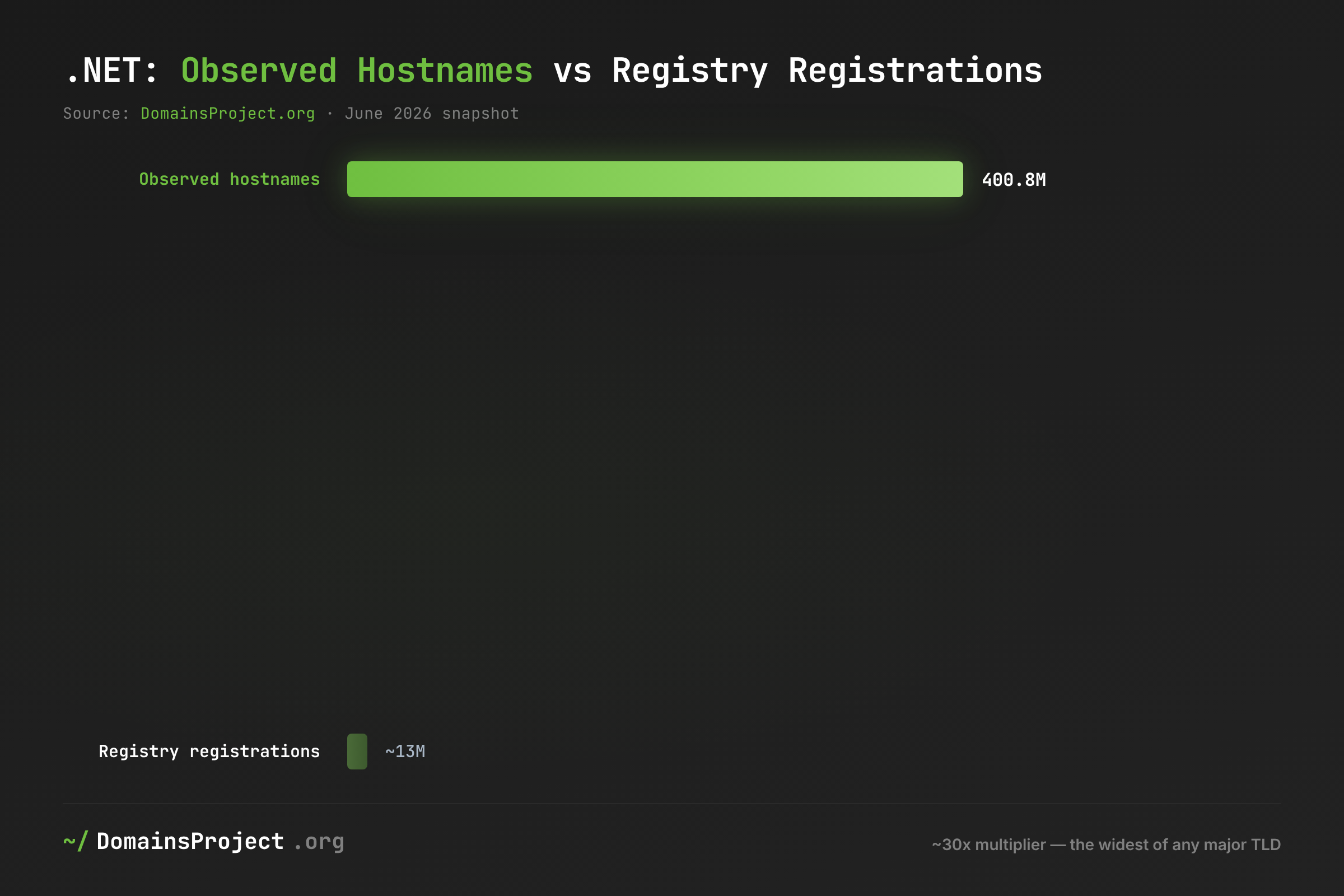
.net ranks second in the entire dataset — behind only .com — yet the registry reports only on the order of 13 million registered .net domains. That ~30x multiplier between observed hostnames and registry registrations is the largest of any major TLD, and it is the single most important fact about .net. For context, mature ccTLDs like .uk, .br, and .nl run multipliers in the 3-6x range. .net's gap is an order of magnitude wider, and it is structural: .net is the default zone for an enormous amount of provider infrastructure, and each registered infrastructure domain mints subdomains — pool-71-184-xxx-xxx.bstnma.fios.verizon.net-style reverse-DNS names, CDN edge identifiers, dynamic-DNS hostnames — by the thousand. Each is a resolvable record in the global DNS. Our crawler found them.
Methodology
This post makes quantitative claims about a single TLD's namespace, so the definitions matter.
- Observed hostname (FQDN). Our base unit: a fully-qualified name we have seen in our crawl.
example.net,www.example.net, andmail.example.netare three distinct hostnames under one registrable domain. The 400.8M figure is deduplicated observed hostnames across the active dataset and its historical GitHub mirror — not registry registrations and not apex-only counts. - Registry registration. A registrable
name.netdomain recorded in Verisign's .net zone. We cite Verisign's Domain Name Industry Brief for this number (on the order of 13 million). It is the right denominator for "how many distinct .net domains exist," and the wrong one for "how many .net names are visible in DNS" — which is what we count. - Infrastructure namespace. We use this label descriptively for hostname mass generated by provider systems rather than by human registrants typing a name into a browser: ISP reverse-DNS, CDN edge nodes, dynamic-DNS services, and mail/hosting back-ends. We infer this character from the ~30x hostname-to-registration multiplier and the high resolution rate, not from a per-hostname classification — this snapshot exports a single deduplicated .net total, so any apex-versus-subdomain split below is described qualitatively and not given a precise figure.
- Resolution. Our 9 June 2026 A-record crawl records hostnames that returned a positive answer (
NOERRORwith at least one IPv4 address). A TLD's resolution rate is the share of its observed hostnames in that positive set. The crawl is positive-only, so the rate is a conservative liveness floor: a live A record can still point at a parking page, and a name that resolves only over IPv6 reads as non-resolving, mildly undercounting liveness. - Why our count diverges from the registry. Two effects pull in opposite directions and the first dominates for .net. We count observed hostnames (which inflates massively relative to apex registrations, because infrastructure domains carry deep subdomain trees), and we count only names our crawl has actually seen (which deflates relative to zone-file totals that include never-used registrations). For an infrastructure-heavy TLD like .net, the subdomain inflation overwhelms everything else, producing the ~30x gap.
Known limitations. This is a single snapshot; it measures presence and resolution, not query volume or uptime. Hostname-weighted counting gives equal weight to a one-page site and a million-host provider tree, which is exactly why .net reads so large. The original edition's per-ISP parent-domain table is not reproduced here because the current export does not carry per-parent counts; treat the infrastructure attribution as a qualitative reading of the multiplier and resolution data, corroborated by the registry gap and the external sources cited below. The headline figures are reproducible from the .net statistics page and the dataset.
The Scorecard: The Internet's Second Namespace
.NET in Context
| Rank | TLD | Type | Observed Hostnames | Global Share | A-Resolution |
|---|---|---|---|---|---|
| 1 | .com | Legacy gTLD | 1,360,818,815 | 42.7% | 57.2% |
| 2 | .net | Legacy gTLD | 400,819,790 | 12.6% | 72.6% |
| 3 | .de | ccTLD | 117,679,029 | 3.7% | 75.2% |
| 4 | .org | Legacy gTLD | 74,404,646 | 2.3% | 55.7% |
| 5 | .jp | ccTLD | 73,446,024 | 2.3% | 76.7% |
.net is the surprise of the table at 400.8 million observed hostnames — more than three times the third-place TLD, Germany's .de. No TLD other than .com comes close. But the ranking is a hostname-counting result, not a registration result: by registry count .net is a distant also-ran with roughly 13 million domains — fewer than .de, .org, or .xyz. By observed-hostname count it is the Internet's second namespace by a wide margin. The gap between those two readings is the single best illustration of why counting methodology matters, and it is the entire subject of this post.
.net's 12.6% global share is built from subdomains, not registrations. Strip the namespace down to its registrable roots and .net collapses by roughly thirty-fold. What remains at 400.8 million is the subdomain mass: the reverse-DNS names of broadband endpoints, the per-account hostnames of dynamic-DNS providers, the edge identifiers of content delivery networks, and the back-end hostnames of mail and hosting platforms. These are machine-generated, never typed into a browser, and invisible to anyone who does not run a traceroute or read a DNS log — yet they are the most numerous category of name under .net by an order of magnitude.
Why .NET Is Infrastructure, Not Websites
The ~30x hostname-to-registration multiplier is not a quirk of one provider; it is the signature of a TLD whose dominant use is infrastructure addressing rather than destination websites. Three structural facts point the same direction.
First, the multiplier itself. A destination-website TLD looks like .com (a ~10x hostname-to-registration ratio against ~160 million registrations) or a mature ccTLD like .uk, .br, or .nl (3-6x). .net's ~30x is in a different regime entirely. Multipliers that large are produced by systems that mint subdomains programmatically: a single registered provider.net can carry hundreds of thousands of reverse-DNS or edge hostnames, each a distinct FQDN in our count but all sharing one registration.
Second, the kinds of operators that historically chose .net. When ISPs, backbone operators, and infrastructure companies built out their networks, .net was the TLD designated for exactly that role, and they used it for the plumbing rather than the storefront. The pattern is visible in everyday network telemetry: run a traceroute and the intermediate hops resolve to names under .net — backbone routers, peering interfaces, regional aggregation points. These names exist to be addressed by machines, not visited by people.
Third, the resolution rate — which we can now measure directly. If .net's mass were parked or abandoned registrations, it would resolve poorly. It does the opposite, which is the strongest single piece of triangulation in this post.
Does It Resolve? .NET Is Live Infrastructure
The infrastructure thesis makes a testable prediction: if .net's hostname mass is real provider infrastructure rather than parked inventory, it should resolve at a high rate, because provider subdomains exist precisely because they point at something. Our 9 June 2026 A-record crawl lets us check.
| Slice | Observed Hostnames | Returns Live A Record | Resolution Rate |
|---|---|---|---|
| .net | 400,819,790 | 291,129,654 | 72.6% |
| .com (for comparison) | 1,360,818,815 | 777,885,100 | 57.2% |
| Whole namespace | 3,183,285,503 | ~1.87B | 58.9% |
72.6% of observed .net hostnames return a live A record — 291.1 million of 400.8 million. That is well above the 58.9% whole-namespace rate and a full 15 points above .com's 57.2%. .net resolves more like a mature ccTLD (.de 75.2%, .jp 76.7%, .nl 71.7%) than like its legacy gTLD peers .org (55.7%) and .info (44.4%), let alone the promotional new gTLDs that resolve below 40%. This is consistent with the infrastructure reading: an ISP does not assign a reverse-DNS name to a broadband line that is not in service, and a CDN does not advertise an edge hostname that points nowhere. Infrastructure names exist because they resolve. A namespace that is simultaneously the second-largest on the Internet and resolves above three-quarters live is not an overflow zone for taken .com names — it is working infrastructure.
The caveat applies here as everywhere: a live A record proves a name answers with an IPv4 address, not that it hosts a human-facing website. For .net that caveat cuts toward the thesis rather than against it — these names are not supposed to host websites. They are supposed to route packets, terminate connections, and serve content edges, and a live A record is exactly the evidence that they do.
The Oldest Domain on Earth: nordu.net and the Original Vision
The first entry in the domain name system was not a .com. It was not a university. It was nordu.net — registered on 1 January 1985 for NORDUnet, the Nordic research and education network collaboration.
nordu.net predates every other domain on the Internet by 73 days. Symbolics.com, commonly cited as the "first domain name," was registered on 15 March 1985. But the DNS records for nordu.net carry a creation date of 1 January 1985 — the day the root zone was initialized with the first TLD entries. NORDUnet's domain served as the identifier for one of the original network hosts. The oldest domain on the Internet was literally a piece of network infrastructure, registered under the TLD designed for network infrastructure.
Jon Postel's RFC 920 (October 1984) defined the initial top-level domain structure: .com for commercial, .edu for educational, .gov for government, .mil for military, .org for organizational. .net was added during implementation specifically for entities "involved in networking technologies." The earliest .net domains were network organizations — nordu.net, nsf.net (the National Science Foundation Network that became the Internet backbone), isi.net (Postel's own Information Sciences Institute), and others.
.net began its life as exactly what it was supposed to be. The deviation came later. By the mid-1990s, the explosion of commercial Internet demand exhausted desirable .com names, and .net had no enforcement mechanism for its "network providers only" restriction. Unlike .edu (verified by EDUCAUSE) or .gov (verified by the US General Services Administration), .net accepted anyone willing to pay. The TLD drifted from its purpose as a registration namespace — and then, through provider infrastructure, drifted back. The 400.8 million observed hostnames in our dataset, sitting on roughly 13 million registrations, are consistent with Postel's original intent realized through a mechanism he never anticipated: not network organizations registering names, but their machines minting them.
Verisign's Dual Monopoly: One Company, Two Critical TLDs
Verisign operates the registry for both .com and .net — the #1 and #2 TLDs in our dataset, which together account for 55.3% of all observed hostnames (1.76 billion of 3.18 billion). No other entity controls two top-level domains of this scale.
The Pricing Paradox: .NET Costs More Than .com
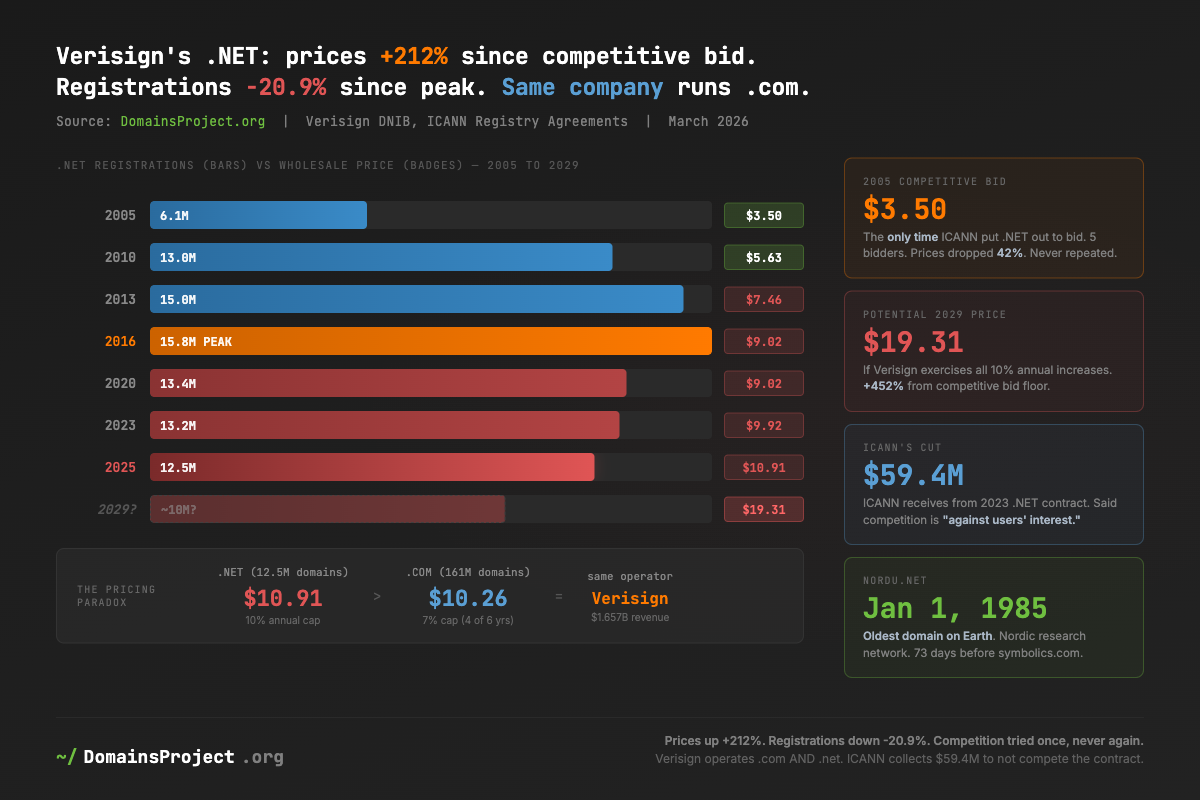
| TLD | Wholesale Price (2024) | Annual Increase Cap | Contract Term |
|---|---|---|---|
| .com | $10.26 | 7% (in 4 of 6 years) | Through Nov 2030 |
| .net | $10.91 | 10% (every year) | Through Jun 2029 |
.net — the smaller registry by registration count, declining year over year — costs $0.65 more per domain than .com and carries a more aggressive price escalation. At full exercise of the 10% annual increase, .net's wholesale price would reach roughly $19 by the end of the current contract in 2029. The trajectory from the 2005 competitive-bid price of $3.50 to that potential 2029 figure represents a more than fourfold increase over 24 years. The pricing is decoupled from the registration trend: Verisign raises prices on a base that is shrinking by registration count even as the observed-hostname namespace stays enormous, because the hostname mass is infrastructure that does not churn the way speculative registrations do.
The Competitive Bid That Was Never Repeated
In 2005, ICANN did something it has never done before or since for a major gTLD: it put .net out to competitive bid. Five consortia submitted proposals — Verisign, Sentan/JPRS (Japan), Afilias, DENIC (Germany), and CORE++. ICANN hired Telcordia Technologies as an independent evaluator, and all five were deemed technically capable. Verisign won, but the competitive pressure drove its bid price to $3.50 per domain — a sharp reduction from the prior rate.
The next .net contract renewals — in 2011, 2017, and 2023 — were not competitive. When the 2023 contract was proposed, the Internet Commerce Association estimated that competitive pricing should place .net at $1-3 per domain. When critics demanded a competitive rebid, ICANN responded that putting TLDs out to bid is "against internet users' interest." Of the roughly 1,200 gTLDs ICANN oversees, .com, .net, and .name remain the only three governed by maximum price restrictions — a structure that, in practice, guarantees Verisign the right to raise prices rather than constraining them.
The Microsoft Collision: When a Trillion-Dollar Company Appropriated a TLD Name
In June 2000, Microsoft announced its ".NET strategy" — described as the company's most ambitious undertaking since its 1995 Internet push. The company branded everything with ".NET": Visual Studio .NET, ASP.NET, .NET Passport, .NET Enterprise Servers, and more.
The .NET Framework shipped on 15 January 2002 — and the naming collision between a programming framework and a top-level domain has persisted for over two decades. Microsoft chose ".NET" to evoke the Internet — the exact same rationale behind the TLD created 17 years earlier. The framework's official website is dotnet.microsoft.com (not dotnet.net or asp.net, both of which Microsoft owns). In November 2020, Microsoft dropped "Core" and "Framework" from its branding, leaving the platform simply called ".NET" — further cementing the collision.
The confusion is not theoretical. Search ".NET" and the first page of results is Microsoft documentation, not the domain extension. The TLD that was supposed to be the Internet's network namespace shares its name with one of the most widely deployed server-side frameworks in existence — chosen, like the TLD itself, because the word "net" reads as "the Internet."
The "Second Choice" Problem: .NET as the Perpetual Understudy
For human registrants who are not running infrastructure, .net occupies an uncomfortable position: universally recognized but rarely preferred. This is the part of the namespace the registration count — roughly 13 million domains — actually measures.
A GrowthBadger study found that .net's memorability score is 25%, versus .com's 44%. Users are several times more likely to guess that a website uses .com regardless of its actual extension. .net has high awareness but far lower recall — people know it exists, but they default to .com when typing an address. Only a handful of the Fortune 500 use .net as their primary domain; the remainder use .com. On the domain aftermarket, every domain sale exceeding $1 million in recent years was a .com.
The notable .net websites that persist — speedtest.net (Ookla), behance.net (Adobe), battle.net (Blizzard), sourceforge.net — tend to be technical or infrastructure-adjacent services, and several are owned by companies whose primary brand lives on .com (Behance at behance.net, owned by Adobe). The pattern is consistent with the dataset: when .net is the destination rather than the infrastructure, it is usually a technical service or an afterthought. The 400.8 million hostnames are not those websites. They are the layer beneath.
What's at Stake
The .net data reveals structural dynamics that extend beyond a single TLD:
-
The second-largest namespace on the Internet is infrastructure, not registrations. 400.8 million observed hostnames sit on roughly 13 million registry registrations — a ~30x gap. The destination-website portion of .net is a fraction of its apparent size; the rest is provider plumbing that no human types but a great deal of traffic traverses.
-
.net resolves at 72.6% — higher than .com and well above the namespace average. Where promotional gTLDs resolve below 40% because their registrations are parked or abandoned, .net resolves like a mature ccTLD, consistent with a namespace of live infrastructure rather than speculative inventory.
-
Verisign operates both .com and .net with no competitive pressure — together 55.3% of all observed hostnames. The only time ICANN introduced competition for .net (2005) drove wholesale prices sharply lower; the experiment has not been repeated.
-
.net's wholesale price exceeds .com's despite a smaller, declining registration base — the pricing is decoupled from registration growth because the registration base is captive: a mix of defensive registrations and the infrastructure operators who built on .net decades ago and face high switching costs.
-
.net's infrastructure layer is a measurement and security asset. A namespace where 291 million hostnames resolve live, encoding provider identity and network topology in their naming patterns, is open-source intelligence about Internet infrastructure hiding in plain sight.
What Would Help
1. ICANN: put .net out to competitive bid again. The 2005 bid produced a steep price reduction and five technically capable bidders. The 2023 renewal produced a multi-year contract with no competition. ICANN's claim that bidding is "against internet users' interest" is contradicted by the only evidence available — the 2005 bid itself.
2. Registrants: audit defensive .net registrations. If you own example.com and example.net solely to prevent others from registering it, calculate the cumulative cost. At $10.91/year rising up to 10% annually, a defensive .net registration runs well into three figures over a decade. For most organizations, that money buys nothing — and it is a measurable fraction of the ~13 million registrations that are not infrastructure.
3. Security researchers: use .net infrastructure data for network mapping. The provider hostnames in our dataset — available at /dataset — encode geography, network type, and provider identity in their naming, and 72.6% of them resolve live. That makes .net one of the most useful open namespaces for mapping broadband and CDN topology. Browse the .net statistics to start.
4. Verisign: publish .net financials separately. Combined .com/.net reporting obscures the economics of a registry whose registration count is declining while its hostname namespace remains the second-largest on the Internet. Investors and regulators cannot assess whether .net pricing is justified if the revenue and cost data are aggregated.
5. ISPs and infrastructure operators: modernize reverse-DNS conventions. The .net infrastructure layer preserves hostnames from decommissioned brands and retired network architectures. Legacy reverse-DNS creates confusion for abuse reporting and network diagnostics; the industry would benefit from an updated standard for naming conventions — which would also make the most useful 72.6% of .net easier to interpret.
This analysis is based on the DomainsProject dataset, which continuously crawls and indexes hostnames across the active TLDs in the IANA root zone (Russian-administered TLDs excluded). The .net namespace contains 400,819,790 observed hostnames in the June 2026 snapshot; resolution figures reflect our 9 June 2026 A-record crawl (291,129,654 live A records, 72.6%). Hostname counts include subdomains and are deduplicated across the active dataset and its historical mirror; they are not registry registration totals. Registry registration counts (on the order of 13 million) are from Verisign's Domain Name Industry Brief. Pricing data is from the ICANN .NET Registry Agreement (2023) and ICANN .COM Registry Agreement (2024). The GrowthBadger memorability study and Fortune 500 figures are from publicly available research. Explore the full .net data on our TLD statistics page, or download the complete dataset.