Updated 23 June 2026 — refreshed against the June 2026 dataset snapshot (117,679,029 observed .de hostnames) and triangulated against our 9 June 2026 A-record crawl. The original March 2026 edition predated our data-journalism format standard and our first-party DNS resolution data. This revision adds a full Methodology section, replaces loose "domain" counts with deduplicated observed-hostname counts, and adds an A-record resolution pass. One number to flag up front: the original edition reported .de at ~162M (and an early draft at 69.9M) on an older counting pipeline; the current deduplicated, Russian-excluded pipeline puts .de at 117.7M observed hostnames. This is a recount on a consistent methodology, not a claim that .de shrank — the Methodology explains the difference.
On November 5, 1986 — one year after symbolics.com became the first .com registration — six domains were entered under .de in the IANA database. Germany's country-code TLD was administered from a university computer lab, maintained by volunteers, and served a country where most people had never heard of the Internet. By January 1994, there were 1,000 .de domains. By 1999, one million. Today, .de resolves into 117.7 million observed hostnames in our dataset — more than .org, more than .xyz, more than the combined Internet presence of most nations.
No other country comes close. Japan's .jp holds 73.4 million observed hostnames. China's .cn — a country with seventeen times Germany's population — holds 52.2 million. Brazil's .br holds 50.3 million, the United Kingdom's .uk 43.8 million, and France's .fr 43.1 million. Germany, a nation of roughly 84.5 million people, operates the largest country-code TLD on Earth, and by observed hostnames it sits ahead of every legacy gTLD except .com and .net.
What makes .de remarkable is not just its size but how it got there. The .com registry is a government-granted monopoly operated by a for-profit corporation charging $10.26 per domain with a 68% operating margin. The .de registry is a non-profit cooperative — DENIC eG, headquartered in Frankfurt am Main — charging EUR 2.20 per domain, employing roughly 100 people, and governed by its own members. No shareholders. No price escalation clauses. No multi-million-dollar payments to ICANN.
We analyzed 3,183,285,503 observed hostnames across 1,511 active TLDs in the DomainsProject dataset, ran a 9 June 2026 A-record crawl to measure how much of .de actually resolves, and cross-referenced the result with DENIC registry reports, the Verisign Domain Name Industry Brief (Q4 2025), Eurostat enterprise statistics, and DENIC's 2024 Domain Map.
The headline: Germany built the world's largest ccTLD not through free registrations, speculation, or government mandates — but through a non-profit cooperative model, millions of small businesses that treat .de as a quality mark, and a privacy-conscious culture that prefers nationally governed infrastructure. And it is unusually live: 75.2% of observed .de hostnames still return an IPv4 address, against a 58.9% whole-namespace rate — so .de's lead is not a counting artifact of parked inventory.
The Data
DomainsProject continuously crawls and indexes hostnames across every delegated TLD in the IANA root zone. Our June 2026 snapshot covers:
| Category | Count | Coverage |
|---|---|---|
| Active TLDs tracked | 1,511 | IANA root zone (Russian-administered TLDs excluded) |
| Total observed hostnames | 3,183,285,503 | Largest public dataset |
| .de observed hostnames | 117,679,029 | 3.7% of dataset |
| .de global rank | #3 | Behind only .com and .net |
| All ccTLDs combined | 971,436,501 | 30.5% of dataset |
| .de share of all ccTLDs | 117.7M of 971.4M | 12.1% |
Counts reflect unique observed hostnames — fully-qualified names (www.example.de, mail.example.de, and the bare example.de are three distinct hostnames under one registrable domain), deduplicated across the active dataset and its historical GitHub mirror. They are not registry registration totals, and they are not apex-only counts. Our 117.7 million .de figure includes subdomains observed during crawling, which is why it exceeds DENIC's reported ~17.7 million registry registrations. Both numbers confirm the same structural fact: .de is the dominant ccTLD on the Internet. The Methodology explains the divergence — and why the headline figure differs from the original edition's.
Methodology
This post makes quantitative claims about a single TLD's namespace and ranks it against others, so the definitions matter.
- Observed hostname (FQDN). Our base unit: a fully-qualified name seen in our crawl.
example.de,www.example.de, andshop.example.deare three hostnames under one registrable domain. The 117.7M figure is deduplicated observed hostnames, not registrations and not apexes. - Apex / registrable domain (eTLD+1). The registered root —
example.de. .de is a flat namespace (no.co.de-style public suffixes), so the apex is always the last two labels. Where this post discusses registrations it cites DENIC's apex-level count (~17.7M), not our hostname count; the two are different units and should not be compared directly. - Registry registration. DENIC's count of distinct registered .de domains (~17.7M at end-2024). This is the figure registry marketing and the DENIC Domain Map report. It is smaller than our hostname count because one registered domain can contribute many observed hostnames, and larger than our resolving count because it includes domains that are registered but never configured to answer in DNS.
- A-resolution rate. Our 9 June 2026 A-record crawl records hostnames that returned a positive answer (
NOERRORwith at least one IPv4 address). A TLD's resolution rate is the share of its observed hostnames that appear in that positive set. For .de: 88,456,659 of 117,679,029 hostnames returned a live A record — 75.2%. A live A record does not prove an active website (it can be a parking page or redirect); a name that resolves only over IPv6 reads here as non-resolving. Treat 75.2% as a conservative liveness floor, not an active-site census. - Why the headline moved. Earlier editions of this post reported .de at ~162M (and an even older draft at 69.9M) on prior counting pipelines that differed in deduplication, subdomain handling, and TLD inclusion. The June 2026 figure of 117.7M is produced by the current pipeline applied uniformly across all 1,511 TLDs, with Russian-administered TLDs excluded throughout. The change is a methodology recount, not a measured decline in .de — we have no longitudinal series on a single consistent pipeline that would support a shrink/grow claim, and DENIC's own registry count was flat-to-slightly-positive over the same window.
- Russian-administered TLDs excluded. Per project policy, Russian-administered TLDs are excluded from the dataset and from every table, ranking, and total here; all global-share and ccTLD-share percentages are computed over the excluded universe.
Known limitations. This is a single snapshot; it measures presence and resolution, not query volume or uptime. Hostname-weighted counting gives equal weight to a one-page site and a thousand-subdomain platform. Registry, geographic-distribution, and infrastructure figures (DENIC's Domain Map, query volumes, the foreign-registrant breakdown) come from DENIC's own publications and are apex/registration-based — we cite them as registry data, not as our crawl. The per-TLD breakdown and resolution figures are reproducible from the .de statistics page and the dataset.
The Scorecard: .de vs. the World
Top 10 Country-Code TLDs by Observed Hostnames
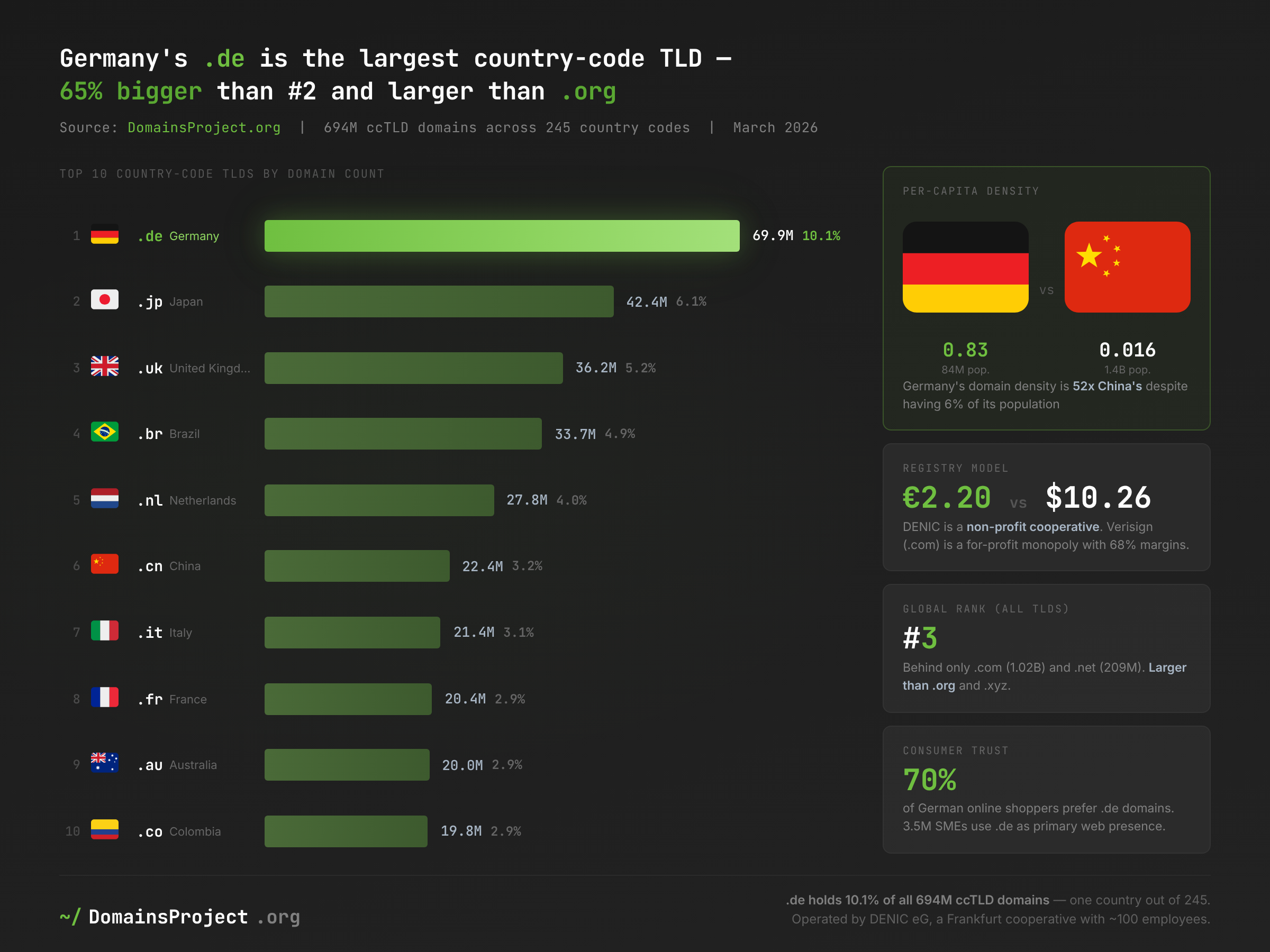
| Rank | ccTLD | Country | Hostnames | Share of ccTLDs | Global Rank |
|---|---|---|---|---|---|
| 1 | .de | Germany | 117.7M | 12.1% | #3 |
| 2 | .jp | Japan | 73.4M | 7.6% | #5 |
| 3 | .cn | China | 52.2M | 5.4% | #6 |
| 4 | .br | Brazil | 50.3M | 5.2% | #8 |
| 5 | .uk | United Kingdom | 43.8M | 4.5% | #9 |
| 6 | .fr | France | 43.1M | 4.4% | #10 |
| 7 | .nl | Netherlands | 36.3M | 3.7% | #11 |
| 8 | .it | Italy | 33.1M | 3.4% | #12 |
| 9 | .au | Australia | 32.2M | 3.3% | #13 |
| 10 | .pl | Poland | 29.3M | 3.0% | #15 |
.de is 60% larger than the second-place ccTLD (.jp) — 117.7M against 73.4M — and the gap is not a recent development; Germany has held the top ccTLD position for over two decades. The combined total of the ccTLDs ranked 3 through 6 (China, Brazil, the United Kingdom, France) is 189.4 million — consistent with a namespace where one country still outweighs the next four major economies' national TLDs taken in pairs.
The population-adjusted picture is starker. China has roughly 1.4 billion people and 52.2 million .cn hostnames; Germany has about 84.5 million people and 117.7 million .de hostnames. That works out to a per-capita observed-hostname density for .de that is on the order of forty times China's — a gap that suggests .de adoption tracks economic structure and institutional trust rather than population size. Even against comparable European economies the same pattern holds: France has roughly 82% of Germany's population but its .fr namespace is about 37% the size of .de's.
.de Among All TLDs
| Metric | Value |
|---|---|
| Global rank (all TLDs) | #3 — behind only .com (1.36B) and .net (400.8M) |
| Larger than .org (#4) | Yes — by 58% (117.7M vs 74.4M) |
| Larger than .jp (#5) | Yes — by 60% (117.7M vs 73.4M) |
| Larger than .cn (#6) | Yes — by 126% (117.7M vs 52.2M) |
| Larger than .xyz (#7) | Yes — by 133% (117.7M vs 50.6M) |
| .de share of all 3.18B hostnames | 3.7% |
| .de share of all ccTLD hostnames | 12.1% |
A single country-code TLD — representing one country out of roughly 245 with ccTLD delegations — holds more than one in eight of all ccTLD hostnames worldwide. .de ranks above .org, the largest of the open-registration legacy gTLDs, despite .org being available to anyone on Earth with no country affiliation. It is the only ccTLD ahead of a legacy gTLD in the global table. Explore the full comparison on our .de statistics page.
Does It Resolve? .de Is Among the Most-Live Major TLDs
Size is one question; liveness is another. A large namespace can be inflated by parked inventory and abandoned subdomains. To test that, we cross-referenced every observed .de hostname against our 9 June 2026 A-record crawl and measured what share still returns a live IPv4 address.
| Slice | Observed Hostnames | Returns Live A Record | Resolution Rate |
|---|---|---|---|
| .de | 117,679,029 | 88,456,659 | 75.2% |
| Whole namespace (all 1,511 TLDs) | 3,183,285,503 | ~1.87B | 58.9% |
.de resolves at 75.2% — sixteen points above the whole-namespace rate of 58.9%, and among the highest of any major TLD. Only a handful of large ccTLDs sit higher (.it at 81.3%, .jp at 76.7%), and .de's rate runs well above the legacy giants it outranks — .org resolves at 55.7% and .com at 57.2%. The promotional new gTLDs are not in the same league: .xyz resolves at 38.8% and .shop at 25.1%. The reading is consistent across the table — a registered .de hostname tends to be a hostname someone is actually using, which is what we would expect of a namespace dominated by domestic businesses and institutions with a standing reason to keep the lights on. It also means .de's #3 ranking is not a counting artifact: by resolving hostnames, .de (88.5M) still clears .org (41.4M) and .jp (56.3M) comfortably.
(Caveat: a live A record can still point at a parking page, and an IPv6-only name reads as non-resolving — so 75.2% is a liveness proxy, not a precise active-site count. The denominator also includes the historical mirror, whose older names are likelier to have gone dark, which pushes the rate down rather than up.)
The DENIC Model: A Non-Profit Running the World's Largest ccTLD
The institution behind .de is unlike any other major registry. DENIC eG is an eingetragene Genossenschaft — a registered cooperative under German law — founded on December 17, 1996, by 37 Internet service providers. It operates on a principle that would be unrecognizable to Verisign's shareholders: income covers costs; surplus is reinvested; profit is not the objective.
DENIC vs. Verisign: Two Models for Running the Internet
| Metric | DENIC (.de) | Verisign (.com) |
|---|---|---|
| Legal structure | Non-profit cooperative | For-profit corporation (NASDAQ: VRSN) |
| Registry registrations | 17.7M | 161M |
| Wholesale price per domain | EUR 2.20/year | $10.26/year |
| Estimated annual revenue | ~EUR 39M* | $1.66B |
| Operating margin | Cost-recovery | 68% |
| Employees | ~100 | 932 |
| Revenue per employee | ~EUR 390K | $1.78M |
| Governance | Member cooperative (~300 members) | Board of directors, shareholders |
| Price increases | Stable (EUR 2.20) | 7% annually (Amendment 35) |
| Regulator relationship | German cooperative law | US Dept. of Commerce contract |
*EUR 39M is implied (17.7M registrations x EUR 2.20); DENIC's official cooperative financials are not publicly disclosed. Registry-registration figures are DENIC and Verisign reported counts, not our hostname dataset.
Verisign charges more than four times as much per domain as DENIC — $10.26 versus EUR 2.20 (roughly $2.40) — and generates on the order of forty times more revenue while managing about nine times more registrations. The difference is not operational complexity. It is the difference between a cooperative that charges what it costs and a monopoly that charges what the contract allows.
DENIC's ~300 member companies — about a quarter of which are based outside Germany — elect the Executive Board and Supervisory Board through a General Assembly. Pricing decisions answer to registrars who are also the owners, not to quarterly earnings expectations. When Verisign raised .com prices by 30.7% between 2021 and 2024 and ICANN received roughly 9,000 public comments (the overwhelming majority opposed), the increases went through anyway. DENIC's EUR 2.20 wholesale fee has remained stable.
DENIC holds ISO 27001 (information security) and ISO 22301 (business continuity) certifications — standards Verisign has never publicly claimed for its .com operations. The cooperative's technical infrastructure handles roughly 6 billion DNS queries per day across 70+ anycast locations on six continents, with over 1.3 terabits per second of bandwidth capacity.
Why Germany: The Structural Advantages Behind .de
.de's dominance is consistent with at least four structural factors that compound over decades — none of which our snapshot can prove causal on its own, but each of which aligns with the namespace's scale and high liveness.
The Mittelstand Effect: Millions of Businesses, One TLD
Germany's economy runs on the Mittelstand — the small and medium-sized enterprises that constitute about 99.2% of all German firms, employ nearly 60% of the workforce, and generate on the order of EUR 5.2 trillion in annual turnover. There are between roughly 3.44 and 3.87 million SMEs in Germany, depending on the definition used.
A large majority of German SMEs establish online presences using .de domains. Germany hosts on the order of 10.6 million websites — close to 30% of all websites in the European Union — and the vast majority run under .de. When a Mittelstand company in Stuttgart builds CNC machines for global export, its website is typically a .de, not a .com. This is consistent with .de's unusually high resolution rate: business sites are configured to answer in DNS and stay that way.
| German Business Data | Value |
|---|---|
| Total SMEs | 3.44–3.87 million |
| Share of all firms | ~99.2% |
| Share of employment | ~60% |
| Annual SME turnover | ~EUR 5.2 trillion |
| SMEs with .de web presence | Large majority |
| Total German websites | ~10.6 million (~30% of EU) |
| Monthly new business registrations | ~64,000–66,500 |
Roughly 65,000 new businesses register in Germany each month — and a significant share register a .de domain within weeks. The Mittelstand is not just a .de customer base; it is consistent with a steady stream of new, resolving .de domains rather than promotional churn.
Consumer Trust: .de as the "Made in Germany" of the Internet
.de functions as the digital equivalent of the "Made in Germany" quality mark. A 2023 survey reported that around 70% of German online shoppers prefer websites with .de domains when making purchases. Over 95% of German consumers prefer information in their native language, and a .de domain signals both locality and language in a single string.
The trust is not only cultural; it is also reflected in our data. .de has long ranked among the lowest-abuse ccTLDs in third-party reputation reporting, and its 75.2% A-resolution rate — far above the promotional gTLDs that dominate abuse telemetry — is consistent with a namespace of genuinely-used sites rather than disposable registrations. When a German consumer sees a .de address, they infer German legal jurisdiction, German data protection, and German consumer protection law — all of which carry weight in a country where a large share of the population actively implements data-protection measures.
Privacy Culture and Data Sovereignty
Germany's relationship with data protection predates the Internet. The Bundesdatenschutzgesetz (Federal Data Protection Act) was enacted in 1977 — nearly two decades before the first million .de domains existed. This is a country where data protection is treated less as a compliance checkbox than as a civic value shaped by historical experience with state surveillance.
| Privacy Metric | Value |
|---|---|
| Germans actively protecting personal data online | ~78% |
| Executives prioritizing digital sovereignty | ~81% |
| Consumers prioritizing data security | ~87% |
| Consumers prioritizing data sovereignty | ~82% |
| Year of first German data protection law | 1977 |
Around 81% of German executives report that their leadership is more concerned about digital sovereignty than a year earlier. This is consistent with .de adoption: a domain registered with DENIC — a German cooperative, governed by German law, with data processed on German infrastructure — satisfies sovereignty preferences that a .com domain, operated by a US corporation under US jurisdiction, does not. After the US government seized Iranian .com domains in 2021, the distinction between US-controlled and nationally-controlled domain infrastructure became concrete rather than theoretical.
Early Infrastructure and Internet Adoption
Germany was an early mover in building the physical infrastructure for mass Internet adoption. In 1993 the Bundespost upgraded the German telephone network to ISDN, giving Germany one of the highest ISDN adoption rates in the world. Deutsche Telekom's 1996 IPO raised approximately EUR 13 billion, much of it reinvested in network expansion. DSL arrived in July 1999, the same month .de crossed one million registrations.
Germany's Internet penetration now stands above 93% — on the order of 79 million users — with broadband near-ubiquitous. The country's e-commerce market reached roughly USD 660 billion in 2024. A large, connected, privacy-conscious population with millions of businesses creates the demand base that is consistent with .de's scale and its high share of live names.
Inside Germany: Where the Domains Are
DENIC's 2024 Domain Map reports that .de adoption is not evenly distributed across Germany. The figures below are DENIC registration counts (apex-level), not our hostname dataset — the economic geography of .de mirrors the economic geography of the country itself.
Registration Distribution by Federal State (DENIC Domain Map)
| State / City | .de Registrations | Registrations per 1,000 Inhabitants |
|---|---|---|
| North Rhine-Westphalia | ~3.4M | — |
| Berlin | ~961,700 | 254 |
| Hamburg | ~630,800 | 330 |
| Munich (city) | ~538,400 | — |
| Cologne (city) | ~369,800 | — |
| National average | — | 184 |
Hamburg leads Germany with about 330 .de registrations per 1,000 inhabitants — nearly twice the national average of 184. Berlin follows at 254. DENIC's Domain Map reports the Miesbach district in Upper Bavaria at an outlying figure of around 629 registrations per 1,000 people, more than three times the national average, which DENIC attributes to a concentration of small businesses and digital agencies south of Munich. Per DENIC, six of Germany's 16 federal states recorded positive .de growth in 2024, led by Lower Saxony and Hamburg, in a year when the global domain market was broadly flat.
The International Footprint
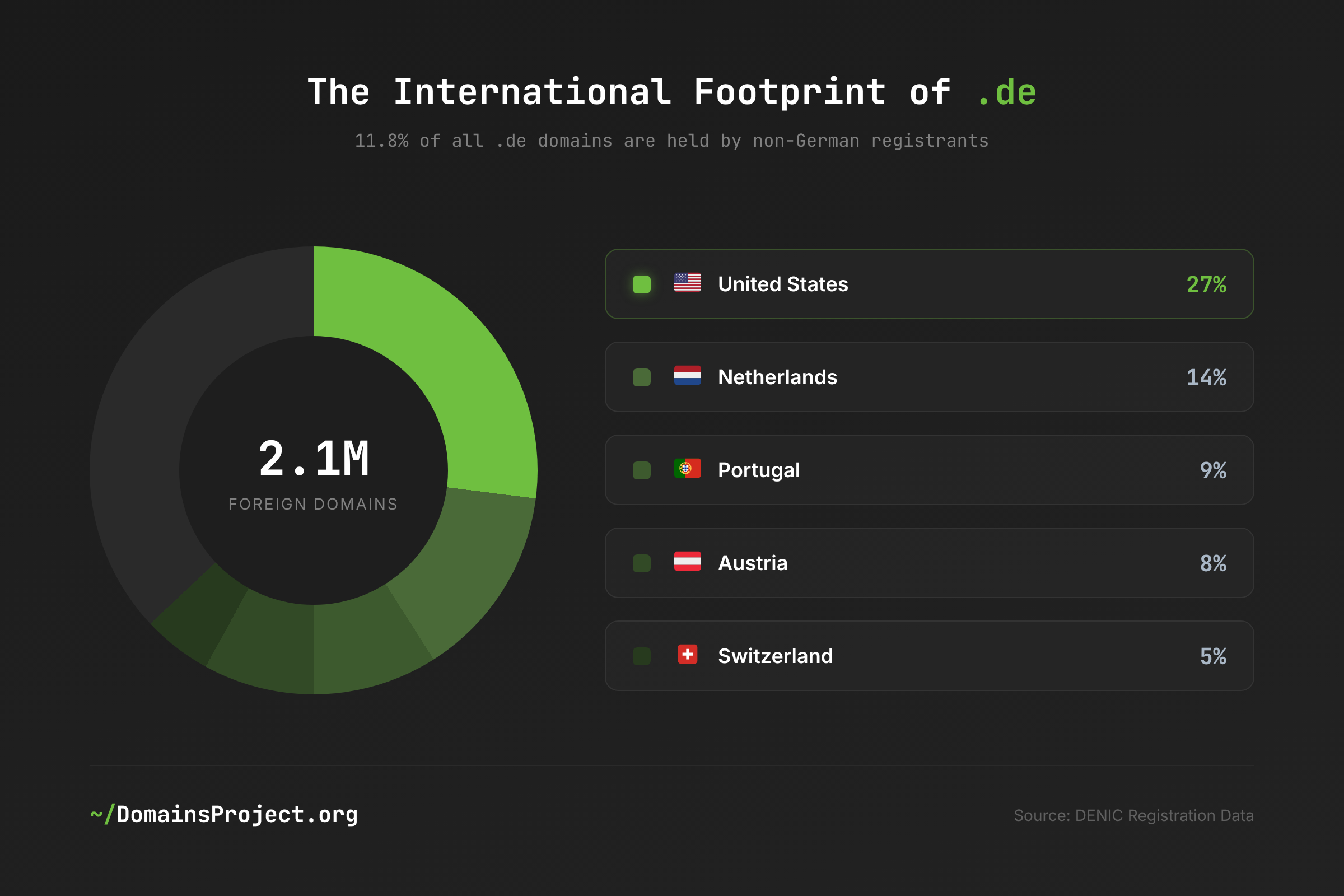
.de is not Germany-only. Per DENIC, of its ~17.7 million registry registrations, about 2.1 million (11.8%) are held by foreign registrants — a share DENIC reports growing at roughly 3% year-on-year.
| Foreign Holder Country | Share of Non-German .de Registrations |
|---|---|
| United States | ~27% |
| Netherlands | ~14% |
| Portugal | ~9% |
| Austria | ~8% |
| Switzerland | ~5% |
American holders are the largest foreign group — about 27% of all non-German registrations. This is consistent with US multinationals establishing German-market presences rather than Germans registering through US entities. The Netherlands at ~14% likely reflects both geographic proximity and the scale of the Dutch hosting industry. Austria and Switzerland — German-speaking neighbors — account for a combined ~13%. DENIC requires non-German registrants to designate a German-based administrative contact for legal correspondence but imposes no citizenship or residency requirement: anyone worldwide can register a .de domain.
The Growth Story: From University Lab to 17.7 Million Registrations
.de's growth trajectory traces the arc of the German Internet itself. The milestones below are DENIC-reported registration counts (apex-level), distinct from our 117.7M observed-hostname figure.
Registration Milestones (DENIC-Reported)
| Milestone | Date | Time to Reach |
|---|---|---|
| 6 registrations | November 1986 | Delegation |
| 1,000 | January 1994 | 7 years |
| 20,000 | Mid-1996 | 10 years |
| 1 million | October 1999 | 3 years from 20K |
| 5 million | November 2001 | 2 years from 1M |
| 10 million | June 2006 | 5 years from 5M |
| 15 million | April 2012 | 6 years from 10M |
| 16 million | 2015 | 3 years from 15M |
| 17 million | July 2021 | 6 years from 16M |
| ~17.66 million | End of 2024 | Current registry count |
The explosive phase was 1999–2006: from 1 million to 10 million registrations in seven years, driven by the dot-com boom, DSL rollout, and the Mittelstand's move online. Growth decelerated after 2012 — it took roughly nine years to add 2 million registrations (15M to 17M) compared with two years to add 4 million during the boom (1M to 5M).
The deceleration is not decline. Per DENIC, .de still adds roughly one million new registrations per year, offset by deletions to produce net annual growth in the low hundreds of thousands. In 2024, DENIC reported that .de grew "contrary to the international trend" — a modest but notable result when the broader domain market was contracting.
Key Institutional Milestones
| Year | Event |
|---|---|
| 1986 | .de delegation — 6 initial domains |
| 1996 | DENIC eG founded as cooperative |
| 2004 | IDN domains introduced (German umlauts) |
| 2009 | Single- and two-letter domains allowed after Volkswagen court ruling |
| 2011 | DNSSEC introduced for .de zone |
| 2016 | ISO 27001 and ISO 22301 certifications |
| 2018 | WHOIS updated for GDPR compliance |
| 2023 | Cloud-native registration system; hosted ICANN78 in Hamburg |
The 2009 Volkswagen ruling reshaped .de's namespace. DENIC had prohibited domains shorter than three characters, but Volkswagen sued to register vw.de — arguing that BMW already operated bmw.de under an inconsistently applied policy. The Higher Regional Court in Frankfurt ruled that DENIC's restriction violated German competition law. From October 23, 2009, single- and two-letter .de domains became available, opening the namespace to registrations like x.de, a.de, and vw.de.
The 2018 GDPR WHOIS update demonstrated DENIC's institutional agility. While ICANN spent years debating WHOIS reform and many registries scrambled to comply, DENIC — operating under Germany's pre-existing data-protection framework — implemented GDPR-compliant WHOIS changes ahead of the May 2018 deadline. The 2023 cloud-native migration was equally significant: a roughly 100-person cooperative rebuilt its core registration system on modern infrastructure, and the same year hosted ICANN78 in Hamburg, drawing some 2,500 participants and underscoring .de's standing as a reference point for registry governance.
The Technical Foundation
DENIC's infrastructure serves roughly 6 billion DNS queries per day — a fraction of Verisign's reported volume, but a substantial operation for a 100-person cooperative. Per DENIC, query volume has more than tripled in the last five years, driven by the same automated crawling and AI-agent traffic that is inflating DNS load globally.
DENIC Infrastructure Profile
| Metric | Value |
|---|---|
| DNS queries per day | ~6 billion |
| Peak query rate | ~125,000 per second |
| Anycast clusters | 6 |
| Global server locations | 70+ across 6 continents |
| Bandwidth capacity | 1.3+ Tbps |
| Data centers | 2 independent facilities |
| DNSSEC status | Among the highest counts of signed second-level domains of any TLD |
.de is a global DNSSEC frontrunner — DENIC reports more DNSSEC-signed second-level domains than any other TLD, including .com. DENIC introduced DNSSEC for the .de zone in 2011 and adoption has accelerated since 2015. This is a measurable security advantage: DNSSEC prevents the DNS-spoofing attacks that redirect users to malicious sites, and .de domains are more likely to be protected than domains under most other extensions.
The cooperative also operates a K-Root server mirror in partnership with DE-CIX in Frankfurt — one of the world's largest Internet exchange points. DENIC migrated its registration system to a cloud-native architecture in 2023 and maintains two independent data centers for redundancy.
.de Domain Characteristics
.de has technical distinctions worth noting for domain professionals and researchers:
| Feature | Detail |
|---|---|
| Minimum length | 1 character (since 2009) |
| Maximum length | 63 characters |
| IDN support | 93 special characters including umlauts (ä, ö, ü) and eszett (ß) |
| Registration restrictions | None — open worldwide |
| Non-German registrants | Must provide a German administrative contact |
| Wholesale price | EUR 2.20/year |
| Retail price range | EUR 5–15/year (via registrars) |
DENIC supports 93 special characters beyond standard ASCII — a broader IDN character set than most ccTLDs, covering not just German umlauts and eszett but characters used in Polish, Czech, and Hungarian. This reflects both linguistic reality and the international makeup of DENIC's registrant base. DENIC recommends registering both the IDN and ASCII variants of a domain (for example, both the umlaut and "ue" spellings) because older browsers may normalize special characters.
What's at Stake
The .de data reveals structural patterns that matter beyond Germany:
- A single country holds 12.1% of all ccTLD hostnames worldwide — consistent with ccTLD adoption being driven by economic structure and institutional trust rather than population size. Germany's ~84.5 million people generate more ccTLD hostnames than China's 1.4 billion, and .de is the only ccTLD that outranks a legacy gTLD globally.
- .de is among the most-live major TLDs at 75.2% A-resolution — sixteen points above the 58.9% whole-namespace rate and well above .org (55.7%) and .com (57.2%). Even by resolving hostnames alone (88.5M), .de holds its #3 position. The lead is in real, configured infrastructure, not parked inventory.
- The non-profit cooperative model is associated with lower prices, stable governance, and high security adoption — DENIC charges EUR 2.20 per domain (versus Verisign's $10.26), has not imposed a 7% annual price escalation, leads in DNSSEC adoption, and holds ISO 27001/22301 certifications.
- .de's registry base has plateaued near 17.7 million registrations — after explosive growth from 1999 to 2006, net annual additions have fallen to the low hundreds of thousands. Future .de growth depends structurally on Germany's ~65,000 monthly new business formations and the ~3%-per-year increase in international registrants; domestic saturation means the Mittelstand engine that built .de cannot scale it indefinitely.
- Around 70% of German online shoppers prefer .de domains — a consumer-trust premium that no amount of gTLD marketing has replicated, and one that aligns with .de's high resolution rate. In a market where .com costs $10.26 and rising, .de offers a cheaper, more trusted, locally governed alternative.
- About 2.1 million .de domains are held by non-German registrants, growing ~3% annually — .de is becoming an international domain, not only a German one. But DENIC's requirement that foreign registrants provide a German administrative contact is a friction point hosting companies and local agents must absorb — a structural cap on international growth that open-registration TLDs like .com do not face.
What Would Help
1. Registry operators worldwide: study the DENIC cooperative model. DENIC demonstrates that a major TLD can be operated as non-profit critical infrastructure rather than a for-profit monopoly. EUR 2.20 per domain covers operations, security certifications, a 70-location anycast network, and DNSSEC leadership — at roughly a quarter the cost of .com. Registries considering governance reform should examine DENIC's cooperative charter as a template.
2. Security researchers: benchmark ccTLD liveness and security against .de. .de combines a leading DNSSEC posture with a 75.2% A-resolution rate — both near the top among major TLDs. Researchers studying DNS security, abuse rates, and registry governance can use .de as a high-water mark against which other ccTLDs and gTLDs are measured. Start with our .de statistics page and country statistics for Germany.
3. Businesses entering the German market: register .de first, not .com. Around 70% of German consumers prefer .de domains. DENIC imposes no residency requirement, retail pricing runs EUR 5–15/year — cheaper than .com — and the domain signals German-market commitment, jurisdiction, and data protection. For any company serious about the German e-commerce market, .de is the entry point.
4. Policy makers: recognize ccTLDs as sovereign digital infrastructure. Germany's national digitalization commitments, including mandates for digital public services, run under .de. The DENIC model shows that national domain infrastructure can be non-profit, member-governed, and technically excellent. Countries dependent on foreign-operated gTLDs should consider whether their national ccTLD receives the institutional investment it deserves.
5. Domain investors and analysts: watch .de's international registrant growth. The ~3% annual growth in foreign .de registrations — particularly the ~27% US share — signals that .de is transitioning from a purely national domain to an internationally recognized trust signal. Track the .de statistics page and DENIC's annual Domain Map for shifts in geographic distribution and per-capita density.
This analysis is based on the DomainsProject dataset (117,679,029 observed .de hostnames in the June 2026 snapshot, out of 3,183,285,503 across 1,511 active TLDs), our 9 June 2026 A-record crawl for resolution figures, and external sources for registry and economic context. Hostname counts include subdomains and are deduplicated across the active dataset and its historical mirror; they are distinct from DENIC's ~17.7 million apex-level registrations. Registry registration figures are sourced from DENIC's 2024 Domain Map and the Verisign Domain Name Industry Brief (Q4 2025); German economic data is from Eurostat, KfW, and Statista; DENIC infrastructure and governance data is from DENIC's official publications. Russian-administered TLDs are excluded from the dataset and from every table and total here per project policy. Explore .de statistics on our TLD statistics page, view country statistics for Germany, browse the full TLD dashboard, or access the complete dataset for your own research.